
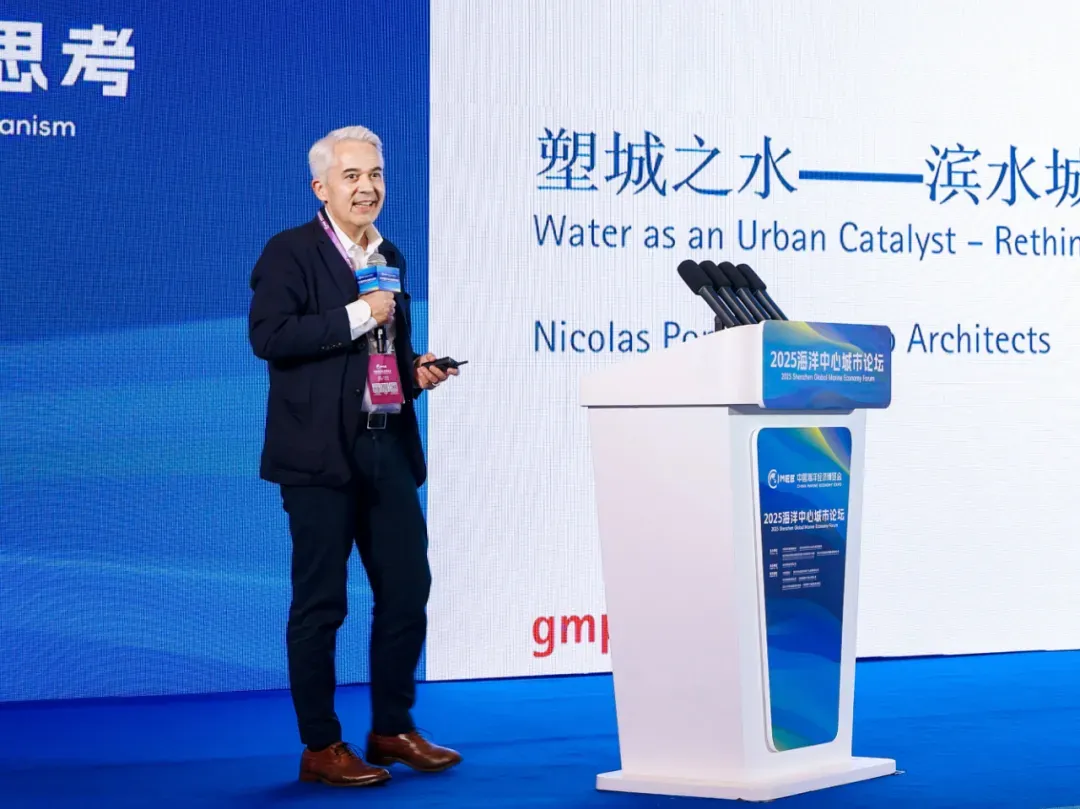
近日,中国海洋经济博览会论坛发布了去年10月底与gmp·冯·格康,玛格及合伙人建筑师事务所合伙人尼古拉斯·博兰克先生的采访对话。在深圳国际会展中心举办的中国海洋经济博览会主论坛2025海洋中心城市论坛以“聚力蓝色创新,澎湃海洋动能”为主题,广邀全球海洋领域政、产、学、研界精英,为海洋经济高质量发展探寻新路径、为海洋治理与蓝色经济合作创造新机遇、为海洋新质生产力与未来增长注入新动能。深圳在建设全球海洋中心城市的过程中,滨海建筑的规划设计是衔接城市功能、市民生活与海洋生态的核心环节,如何实现三者的有机统一成为行业关注的重点。
Recently, the China Marine Economy Expo Forum released an interview with Nicholas Pomränke, partner of gmp · von Gerkan, Marg and Partners Architects, which took place at the end of October last year. The main forum of the China Marine Economy Expo, the 2025 Ocean City Forum, held at the Shenzhen International Convention and Exhibition Center, was themed "Gathering Blue Innovation, Empowering Marine Dynamics", inviting global elites from the political, industrial, academic, and research sectors in the marine field to explore new paths for the high-quality development of the marine economy, create new opportunities for marine governance and blue economic cooperation, and inject new impetus into marine new quality productivity and future growth. In the process of building a global marine center city, the planning and design of coastal buildings in Shenzhen is a core link that connects urban functions, citizens' lives, and marine ecology. How to achieve the organic unity of the three has become a focus of industry attention.
尼古拉斯・博兰克1998年在布伦瑞克工业大学完成建筑学学业后加入了冯·格康,玛格及合伙人事务所,于2002年在北京参与了gmp首个中国办公室的设立,2021年成为合伙人。他是青岛大剧院、天津大剧院、青岛国际贸易中心、珠海博物馆、唯品会总部大厦、京东集团西南总部大厦、深圳渔人码头新玺ONE、中欧蓝色产业园和德累斯顿文化宫等项目的负责人。目前他负责的项目有小米集团昌平总部、深圳前海枢纽以及基尔城堡音乐厅的修建工作。此外,博兰克自2009年起在建筑文化学院(aac)参与教学工作。
Nicolas Pomränke studied architecture at TU Braunschweig, from where he graduated in 1998. Since then he has been working for gmp where, in 2002, he was involved in establishing the practice’s first Chinese office in Beijing; he became Partner in 2021. The projects for which he has been responsible include the Grand Theaters in Qingdao and Tianjin, the Tsingtau Center in Qingdao, the museum in Zhuhai, the headquarters for vip.com and JD.com as well as OCT the One in Shenzhen, China Europe Blue Industry Park and the Kulturpalast in Dresden. He is currently working on the Xiaomi headquarters in Beijing Changping, Shenzhen Qianhai Transportation Hub and the refurbishment of the concert hall at Kiel castle. In addition, Nicolas Pomränke has been teaching at the Academy for Architectural Culture (aac) since 2009.
采访基于博兰克参与的深圳滨海建筑项目实践,就水元素融合、滨水设计理念及城市韧性建设等议题,带来了专业且贴合实际的深度见解。以下为部分采访实录。
The interview, based on Pomränke's participation in the Shenzhen coastal architectural practice, brought professional and practical in-depth insights on issues such as the integration of water elements, waterfront design concepts, and urban resilience construction. The following is part of the interview transcript.
兼论城市韧性与论坛价值
解码深圳滨海建筑设计
Q: 在您参与设计的项目中,例如深圳渔人码头和前海国际枢纽中心,您是如何将水元素与城市功能和市民生活有机结合的?
In the projects that you have participated in the designing, such as the Fisherman's Wharf in Shenzhen and Qianhai Hub, how do you integrate the elements of water with the functions of the city and the life of the citizens?
尼古拉斯·博兰克:我认为,首先,当然是技术层面的考量,也就是如何将观水视野最大化。无论是在海滨居住,还是在海滨工作,人们都期待能欣赏到水景。所以,我认为最大程度地展现水景,是首要的技术难题之一。对于地面层空间的生活以及人与水的互动而言,或许更重要的是,真正实现亲水性。也就是说,通往水边的道路上不应有车辆穿梭,同时要打造出高质量的区域景观。亲近水面应当极其便捷、直接,绝不应受到交通或其他因素所阻碍。
Nicolas Pomränke:So I think, first of all, of course, it's the more technical issue to provide maximized view to the water. So if you live by the waterfront or you work there, you expect to see the water. So maximizing this view, I think, is one of the most important technical issues. Maybe more important for the life on ground floor and the relation, the physical relation to water, is to have access to water, so direct access, so no cars crossing that path to have a high quality landscape in this area, so that accessing the water should be very easy, it should be very direct, it should not be obstructed by traffic, for example, and other kinds of problems.
我们应该考虑的另一个问题,是如何在建筑中融入“故事性”的元素,使其与海洋文化或海洋美学产生关联。这可能体现在建筑的外观上,比如有些建筑会通过水平栏杆、白色调和船体造型来模仿船只;又或者,建筑能让人联想起波光粼粼的水面,通过生动的立面设计,捕捉并呈现出光影的变幻;再或者,建筑以波浪为原型,与水的形态和感性认知产生直接的呼应。
And maybe another issue or another topic is to have a sort of storytelling relation, so that buildings have a relation to maritime culture or also maritime aesthetics, so maybe it's like sometimes a building could look like a boat with horizontal railings and white color and shapes like a boat, or it could remind of the sparkling surface of the water so that we sort of sight these light effects with a very vivid surface or it has a form of waves which has a direct relation to the shape and the... let's say, sensitive perception of water.
Q: 您认为与过去相比, 在当代的滨水城市设计中,最重要的考量点是什么?
So what do you think is the most important shape in contemporary waterfronts urban design compared to the past?
尼古拉斯·博兰克:如今的设计首先要以人为本。正如我们在Barry先生的发言中也看到,在七八十年代或上世纪末,交通曾是考虑的重中之重,但现在我们认识到,要建设宜居城市,就必须把人放在首位。这就是我刚才提到的,要让人能够直接亲近水。所以,人是第一位的,交通问题应该通过其他方式来解决。我认为这是普遍认知的一个重大转变,不仅是对建筑师而言,对政府官员和市民来说也是如此。市民期待能够直接亲近水资源,他们或多或少享有获取水资源、从中受益的权利并在城市里过上亲近自然(即滨水地带)的高品质生活。
Nicolas Pomränke:I think that today humans are put first, so as we saw also in this speech from Barry that, for example, in the 80s or 70s or the end of last century, traffic was most important, but now we understand that to have a livable city, people are first, so this is what I said before, this direct access to water, so people first, traffic should be handled in another way, I think this is a big change in common understanding not only for architects but for people in the government and also citizens, they have the expectation to have direct access to the water, they have more or less a right to access the water and benefit from these qualities and have a very attractive life in cities but close to nature, which is the waterfront.
Q: 在全球气候变化的严峻挑战面前, 海滨城市如何才能更具韧性?
So in the face of the global climate change, how can the desire of waterfront cities be made more resilient?
尼古拉斯·博兰克:我认为途径很多。从长远看,核心是可持续发展,也就是努力减少能源和资源的消耗。减少资源消耗可能更具挑战性,但这或许才是真正减缓乃至阻止气候变化的有效途径。这是长期目标。不过,我们眼下必须立即采取行动,这正是“韧性”理念的体现。我们要确保城市能够抵御暴雨等侵袭,就像我展示的那些项目一样,正视这些挑战的存在,并以一种兼顾建筑美学和技术创新的方式来加以应对。我们可以将这些雨水保护设施打造为极具吸引力的公共空间。
Nicolas Pomränke:I think there are many ways. In the long run of course it's about sustainability so that we try to reduce the energy consumption, resource consumption, which is maybe even more difficult, which might really lead to weakening the climate change and to stop it, this is on the long run but we have to already act on short notice right now, which is more this resilience idea, so that we can protect our cities from stormwater or these projects I showed
that we accept that these challenges are there and that we can find technical solutions in an aesthetic architectural way to deal with them, so like these stormwater protections which can turn into a very attractive public space.
Q: 请问您对本届论坛的总体感受是什么? 您对海洋中心城市论坛的未来持续发展有何展望和期许?
What is the overall impression of the forum? And what is your vision and expectation for the continuation of GMEF in the future?
尼古拉斯·博兰克:令我难忘的是,与会专家们所代表的科学领域、研究方向和思想观念极其多元和广泛。当然,召开会议的目的正是将这些因素汇集一起。我认为最关键的一点是,能让大家.....如果你参加一个会议,听到一场演讲,心想“嗯,很不错”, 然后你会主动与演讲者交流。
Nicolas Pomränke:I was impressed about the range of experts from very different science and directions and ideas. And of course the idea of a conference is to bring these together, I think this is the most important thing to let you... If you join a conference and you hear a speech and think oh that's interesting, I talk to him and this is...
我认为,将大家聚首一堂正是会议的意义所在。这或许也是因为,作为建筑师,我们对很多领域都了解甚少,但涉猎很广。因此,每当我们开展工作时,总是需要就一些具体问题咨询专家。所以,本次会议的目的或许也在于此,希望各位能够找到合适的专家,携手合作。
I think bringing people together is the idea of a conference and that's maybe, as an architect you know a lot about every thing but no sorry. Very little, but about everything, so whenever we work, we ask experts about special things and so this is maybe also an idea about this conference that you find the right expert to cooperate together.
公共关系与出版交流
上海 T: +86 21 54 64 75 32
北京 T: +86 10 57 85 83 26
汉堡 T: +49 40 88 151 0
E:public.relations@gmp.de
更多资讯,请关注gmp公众号

www.gmp.de
