
静默的爆裂
Silent Detonation
王楚然 Wang Churan
艺术总监|Artdirector
刘大海 Liu Dahai
学术主持|Academic Host
夏海明 Agustín Alepuz Morales
摄影指导| Photography Director
胡方涛 Hu Fangtao
平面设计|Graphic Design
宋成儿 Song Chenger
钢铁想要成为永恒,
但它最终教会我们的是,
如何面对消逝。
Steel would gladly last forever,
But in the end it teaches us—
How to greet what fades so fast,
And in the embers, recognize ourselves.
“这些画是我这一辈子二十五年的感受”。
艺术家王楚然的这句口头禅经常受到长辈和朋友们的嘲笑,笑他不明白二十五岁是多轻薄的年纪,远和一辈子挂不上钩。但恰恰又是这二十五年的生命轨迹,坐落在了多重历史力量的交汇点上。
1931年“九⼀八”事变后,日本全面控制东北,迅速建立起以满铁和昭和制钢所为核心的国策会社式钢铁产业控制体系,并于1937年12月1日设立“鞍山市”,其行政完全服务于殖民掠夺。而在这座城市正式设立之前,日本已通过满铁(1906年设立)、振兴公司(1916年假合办攫取矿权)、鞍山制铁所(1918年设立)、昭和制钢所(1933年由满铁全额出资设立并整合鞍山制铁所)等分阶段推进的殖民产业扩张渠道,非法勘探、开采了鞍山矿产近三⼗年。
鞍山市的核心是工厂与矿场,所有规划都服从于如何最高效地掠夺和运输资源。铁路等交通干线被精心设计,直连工厂和港口,形成⼀个完整的掠夺链条。在严密的控制和血腥压榨下,到1943年,鞍山的钢铁产量达到铁130万吨、钢84.3万吨、钢材49.5万吨。据《鞍山志•鞍钢卷》记载,从1916年至1945年,日本从鞍山地区掠夺的钢铁资源总量超过了1000万吨。紧接而来的是新中国建立后鞍钢作为“国家工业化引擎”,在1949-1999年的半个世纪里累计钢产量2.64亿吨。在技术相对落后的年代,鞍钢的能源结构单一,消耗巨大。以当时典型的高炉为例,其焦比(冶炼一吨铁消耗的焦炭量)接近1000千克,仅鞍钢一家企业的年能耗,就高达一千多万吨标准煤。在相当长的历史时期里,“天上烟龙飞舞,地下污水成灾”是鞍钢厂区的真实写照。矿山开采对生态环境造成了严重破坏,截至2017年底,鞍山全市因矿山开采占用破坏的土地资源总面积高达8446公顷。伴随着自然资源枯竭、环境破坏同时发生的,是机构臃肿、设备老化、社会负担沉重等问题导致的巨额亏损和影响数十万人家庭的下岗浪潮。
王楚然在2001年出生时,环绕着他的童年的,是无法轻易停下的机器轰鸣和大量工人被分流,留下的职工也时常面临工资拖欠、发不出或减半的窘境所导致的社会躁动,直到2015年,少年十四岁时,长辈口中作为“共和国长子”的鞍钢集团巨亏45.9亿元,进入行业“冰河期”。宏大叙事的荣耀与他直观感受到的个体生活的匮乏形成强烈且无可回避的冲突,像一根钢管扎穿所有。
细看鞍山乃至东北地区每一个被多重历史力量萦绕的具体生命,都无法回避空间暴力批判理论与政治经济学的交叉理论框架下的Colonial Legacies(殖民遗产)、Resource Curse ( 资 源 诅 咒 ) 、 Extractivism ( 榨 取 主 义 ) 与IntergenerationalTrauma(代际创伤)。也正是这份沉重的历史感知,促使王楚然选择了城市设计作为自己的第一专业——他渴望读懂藏匿于城市空间肌理中的历史回响 。
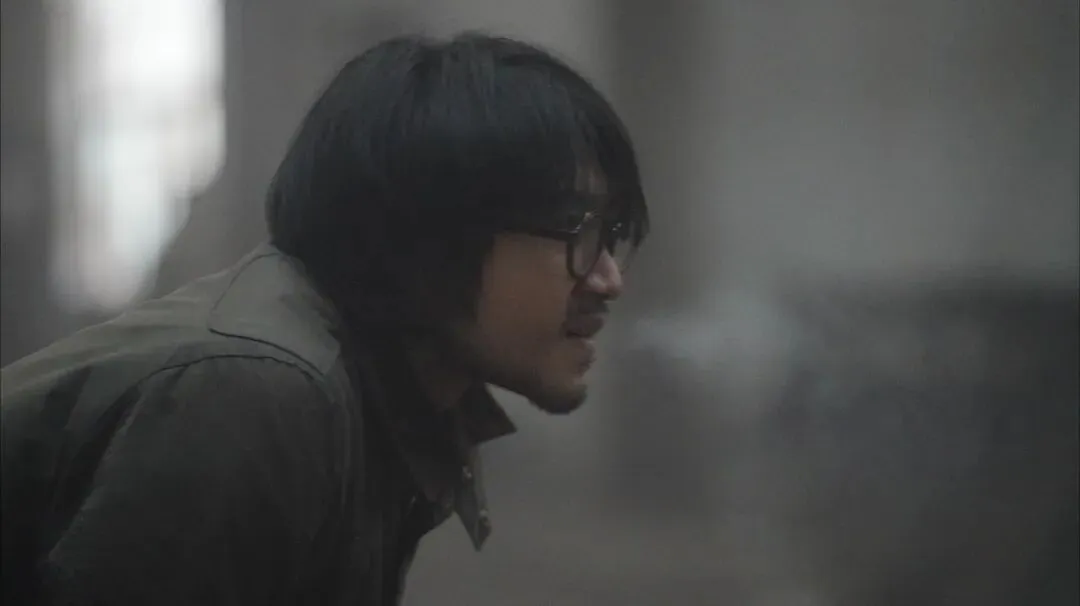
2022年与2023年,王楚然先后被中国鲁迅美术学院与英国皇家艺术学院录取,目前已以英国皇家艺术学院奖学金获得者的身份毕业,并正在鲁迅美术学院继续攻读第二硕士学位。值得关注的是,历经世界顶尖艺术学院的学术洗礼以及校园内微型国际社会带来的反复认知冲撞之后,王楚然回国后将城市设计专业之外的全部精力 ,悉数倾注于绘画、装置与行为的当代艺术实践之中 。
四个月时间,他完成了八十余幅作品,创作状态近乎偏执。
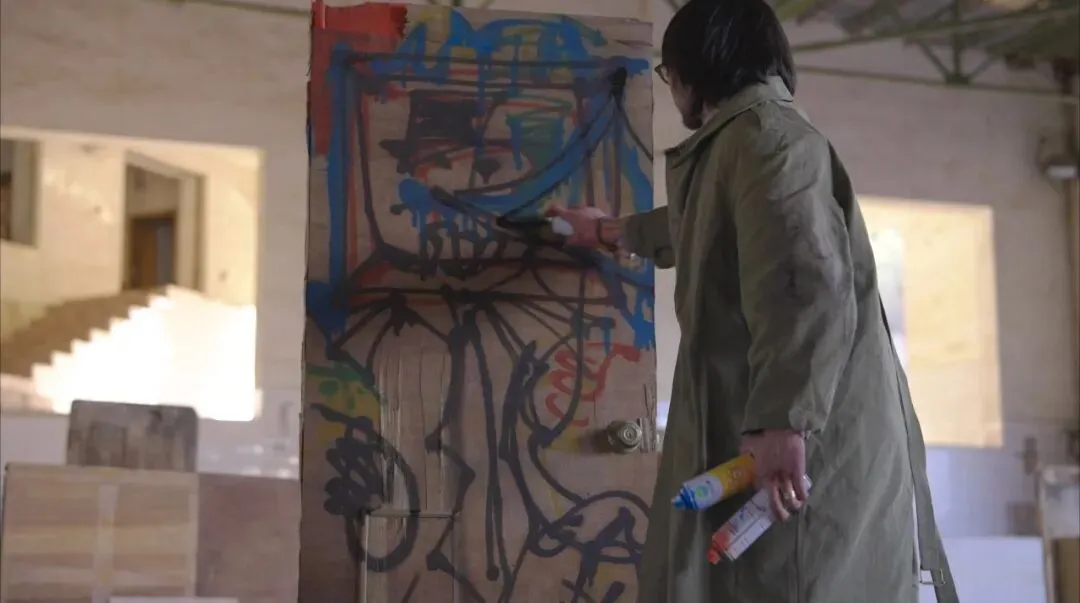
他仿佛一个无法闭嘴的人——唯有凭借持续、不容中断的轰鸣,才能填满自身存在的缝隙。这也解释了为什么,观看他的绘画作品录像时,更像是在旁观一场以艺术为名的暴力。童年钢厂的重击声、粉尘、铁锈,在他的创作中,完成了新一轮静默的爆裂。而绘画,则变成了一个将历史暴力与童年经验层层压缩、最终沉淀为物质痕迹的过程。
The catchphrase of young artist Wang Churan is, "These paintings are the feelings of my entire life—all twenty-five years of it."
This remark is often met with ridicule from elders and friends, who laugh at his failure to grasp how frivolous an age twenty-five is, and how little it can be said to encompass "a whole lifetime." Yet it is precisely those twenty-five years of lived experience that sit at the intersection of multiple historical forces.
Following the Mukden Incident of 1931, Japan took full control of Northeast China and swiftly established a state-corporate steel industry control system centered on the South Manchuria Railway Company (SMR) and Showa Steel Works. On December 1st, 1937, it formally created the city of "Anshan," whose administration was entirely subordinated to colonial plunder. Even before the city's official establishment, Japan had already spent nearly three decades illegally surveying and extracting Anshan's mineral resources through a phased expansion of colonial industrial channels: the SMR (founded 1906), the振兴 Company (which secured mining rights via a sham joint venture in 1916), the Anshan Ironworks (founded 1918), and Showa Steel Works (fully funded by the SMR in 1933, which absorbed the Anshan Ironworks).
The city's core was its factories and mines, and every planning decision served the efficient extraction and transport of resources. Railways and other transport corridors were deliberately laid out to connect directly to plants and ports, forming a complete extraction chain. The colonizers reinforced social stratification through spatial design: villa districts for senior Japanese managers occupied elevated, privileged hillside terrain, while Chinese laborers were relegated to squalid dormitory zones near the factories—such as the "Bagua Ditch" area at the boundary of present-day Tiedong and TiexiDistricts, which once marked the dividing line between Japanese-occupied and non-occupied zones and bore the brunt of ensuing environmental degradation and pollution.
Under strict control and brutal exploitation, Anshan's steel output surged dramatically. By 1943, annual production had reached 1.3 million tons of pig iron, 843,000 tons of crude steel, and 495,000 tons of rolled steel. According to the Anshan Chronicles: AnsteelVolume, between 1916 and 1945 Japan plundered over 10 million tons of iron and steel resources from the Anshan area.
Immediately after the founding of the People's Republic of China, Ansteel—hailed as the "engine of national industrialization"—produced a cumulative 264 million metric tons of crude steel in the half-century from 1949 to 1999.
In an era of comparatively backward technology, Ansteel'senergy mix was narrowly concentrated, and its consumption was enormous. For a typical blast furnace at the time, the coke ratio (the amount of coke consumed per ton of pig iron produced) approached 1,000 kilograms. Ansteel's annual energy consumption alone exceeded ten million metric tons of standard coal equivalent. For a long period, "dragon-like plumes of smoke in the sky and flooding sewage on the ground" aptly described the Ansteelplant area. Mining also inflicted severe ecological damage; by the end of 2017, the total land area occupied and destroyed by mining operations in Anshan had reached 8,446 hectares.
Resource depletion and environmental degradation were accompanied by steep losses from institutional bloat, aging equipment, and heavy social burdens, as well as waves of layoffs that affected hundreds of thousands of families. When Wang Churan was born in 2001, his childhood was shaped by the relentless roar of machinery that never seemed to stop, large-scale worker reassignment, and unrest triggered by frequent wage withholding, nonpayment, or cuts among those who remained. This atmosphere lasted until 2015, when Wang, then fourteen, saw Ansteel—once praised by elders as the "eldest son of the Republic"—report a staggering loss of 4.59 billion yuan and enter an industry-wide "ice age."
The grand narrative of national glory collided with the material scarcity of everyday life, a contradiction that pierced everything like a steel pipe driven straight through it. A close examination of concrete lives in Anshan—and across the Northeast—haunted by multiple historical forces brings into view intersecting frameworks from critical studies of spatial violence and political economy. Through these lenses, analytical prisms such as colonial legacies, the resource curse, extractivism, and intergenerational trauma come into focus. This weighty historical consciousness drove Wang Churan to choose urban design as his first major: he wanted to decipher the echoes embedded in the very texture of urban space.
In 2022 and 2023, Wang was admitted successively to the Lu Xun Academy of Fine Arts in China and the Royal College of Art in the UK. He has since graduated as an RCA scholarship recipient and is currently pursuing a second master's degree at the Lu XunAcademy. Notably, after the academic rigor of world-class art institutions and repeated cognitive collisions within the miniature international community on campus, Wang returned to China and poured his energy—beyond his work in urban design—into contemporary art practices in painting, installation, and performance.In four months, he completed more than eighty works, his creative state bordering on obsession.
He resembles someone who cannot close their mouth: only a sustained, unbroken roar can fill the voids within existence.
This helps explain why watching a video of his paintings feels less like viewing art than witnessing an act of violence carried out in its name. The heavy clang of the steel mill from childhood, the dust, the rust—all of it undergoes a new, silent detonation in his work. Painting becomes a process of compressing historical violence and childhood experience layer upon layer, until they finally precipitate into material traces.
Swipe to see more
Chapter 1
故人来信
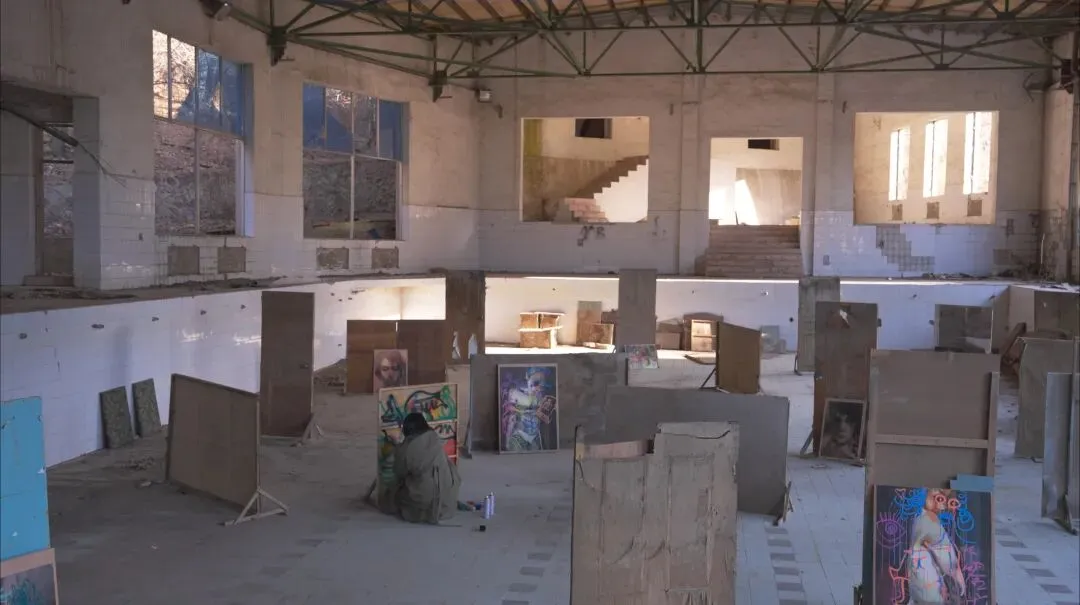
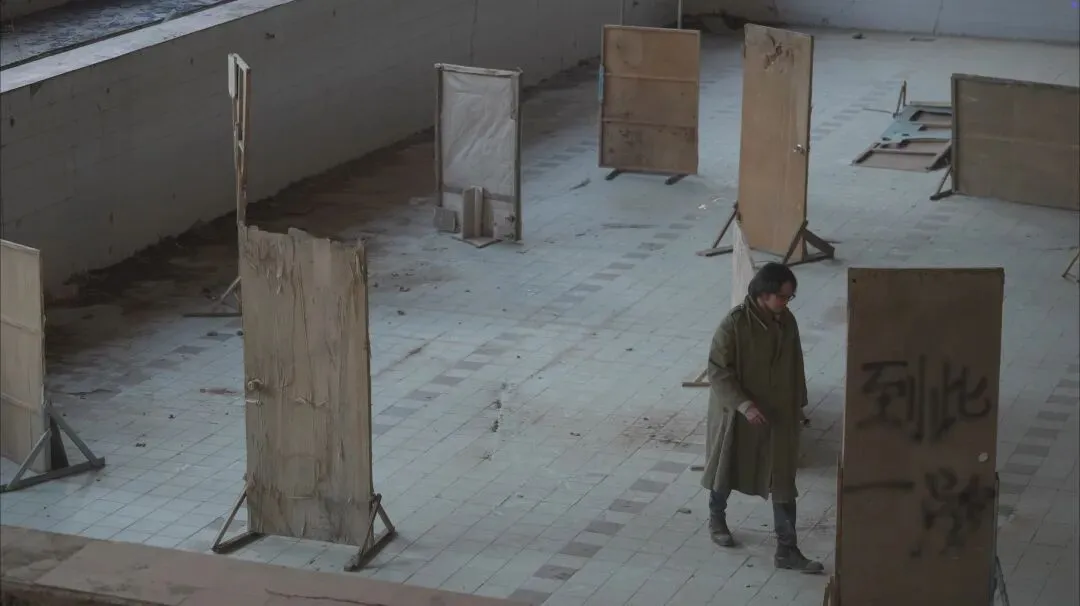
2026年4月,王楚然回到故乡鞍山,在他父亲曾工作过的工厂里,举办了一场“没有观众”的展览。他邀请青年电影人胡方涛,用镜头记录下自己的画作与这片空间最直接的对望。
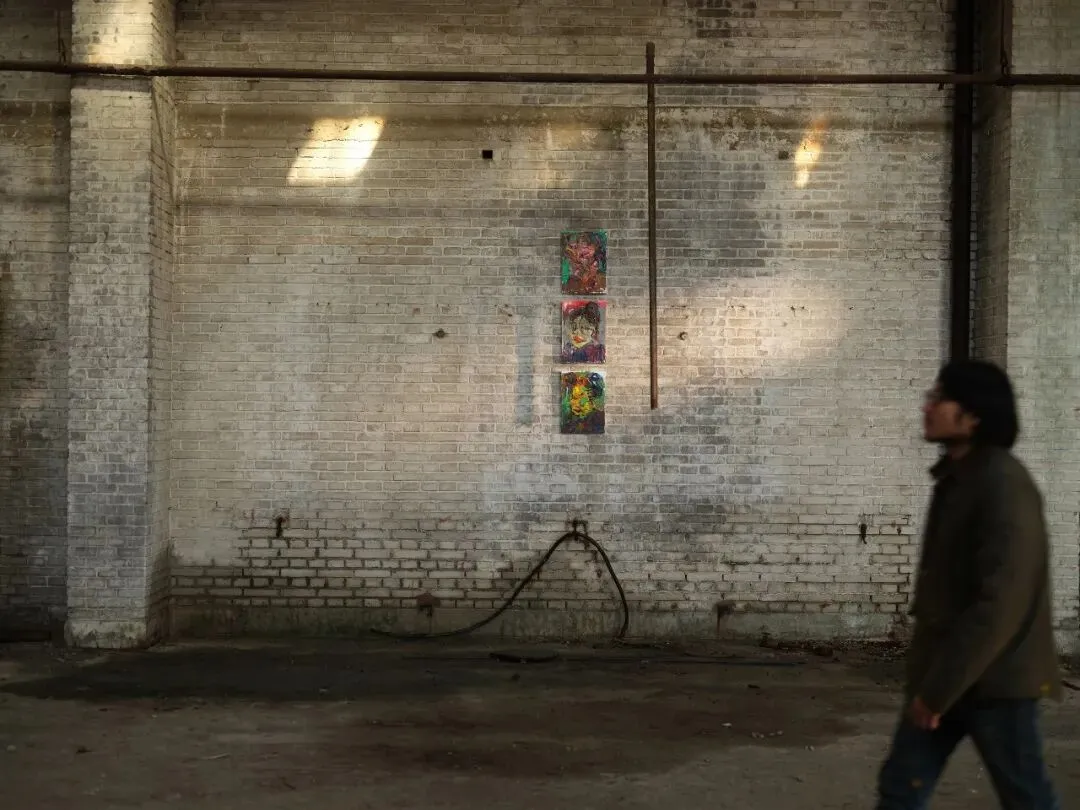
故人来信6、7、8
Portraits of The Memory 6、7、8
2026
布面油画、丙烯、喷漆
Oil, acrylic and spray paint on canvas
30x42 cm
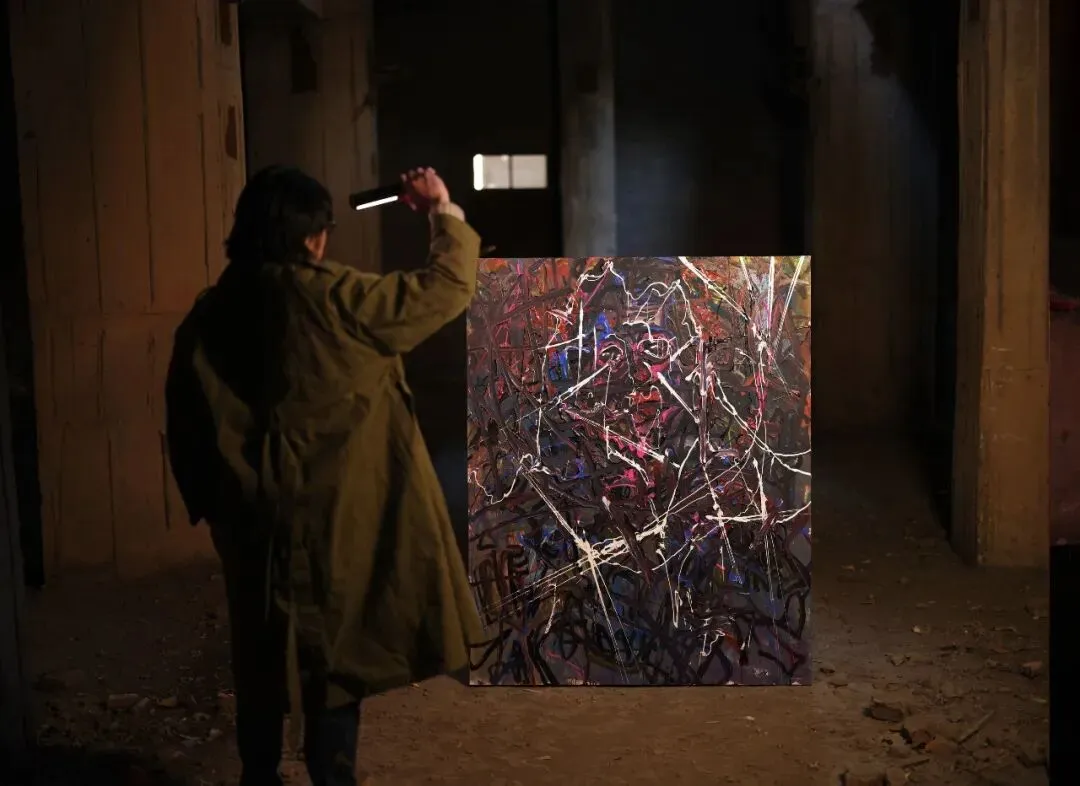
故人来信12
Portraits of The Memory 12
2025
布面油画、丙烯、喷漆
Paint, acrylic paint, glycerin
120x150 cm
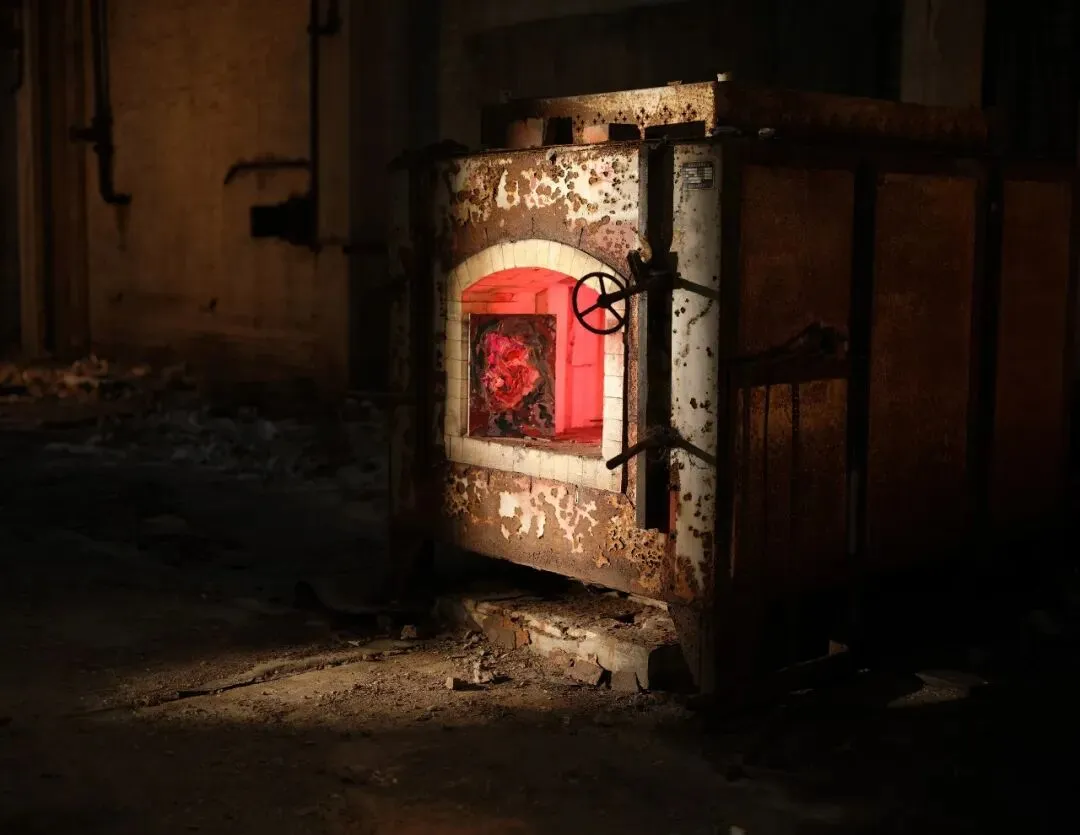
故人来信 10
Portraits of The Memory 10
2025
布面油画、丙烯、喷漆
Paint, acrylic paint, glycerin
30x42 cm当年的车间早已人去楼空,热火朝天的生产线沉寂多年,只剩下漂浮在空气中、引人咳嗽的霉菌孢子。在这片既熟悉又陌生的场景里,王楚然凭借记忆与情绪画下的男人们、女人们,随着镜头的平移缓缓浮现。
有时他们仿佛刚从生产线上下来,火急火燎,说不清是天冷还是肺里灌满了粉尘,脸憋得通红。有时刚为琐事激烈争辩,五官还堆积着愤怒和愁苦。有时应该也还是遇到了爱⼈,但又被现实搅动到模糊。
这些脸,被开采、被透支、被卷走又被抛下。每⼀次回忆都是⼀次新的剐蹭,直到最后混合着铁水、锈迹、尘土被搅烂,无法辨认。
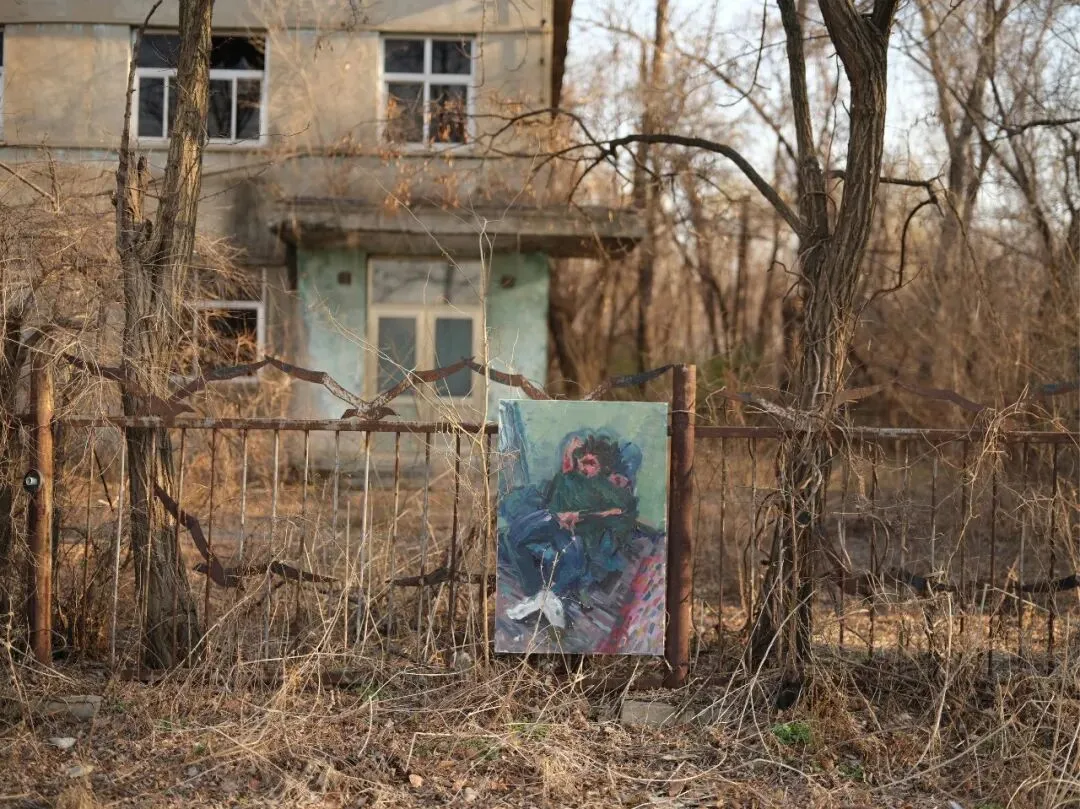
故人来信 5
Portraits of The Memory 5
2025
布面油画、丙烯、喷漆
Oil on canvas, acrylic, spray paint
80x120 cm
Chapter 1
Portraits of TheMemory
In April 2026, Wang Churanreturned to his hometown, Anshan, and mounted an exhibition—one with "no audience"—inside the very factory where his father had once worked. He invited the young filmmaker Hu Fangtao to document, through the lens, his paintings’ most unmediated encounter with the space itself.
The factory, once a hive of industrial fervor, now stands deserted. The production lines that roared for years have long fallen silent, leaving only airborne mold spores that draw a dry cough from anyone who lingers. Amid this scene—at once familiar and uncanny—the men and women Wang painted from memory and emotion slowly emerge as the camera glides through the space.
At times, they seem to have just stepped off the assembly line—rushed and breathless, their faces flushed a deep red—one cannot tell whether from the cold or from lungs packed with dust. At other times, they look as if they have just been locked in a heated quarrel over something trivial, their features still contorted with anger and bitterness. Now and then, they might have met a lover, only to be blurred again by reality’s churn.
These faces have been mined, overdrawn, swept away, and abandoned. Each recollection is a fresh abrasion until, finally, mixed with molten iron, rust, and dust, they are ground into an indistinguishable pulp.
Swipe to see more
Chapter 2
25岁的一辈子
这是一组视觉日记。艺术家王楚然以一个孩童的视角,记录了自己“二十五岁的一辈子”。最初的《世界》,是钢厂里飞溅的铁花。那是几代东北人记忆中的雀跃与狂欢,也是这个孩童出生后第一眼捕捉到的奇异景色——漫天火星坠落,像一场永不落幕的烟花。后来,他发现自己与周遭的一切开始格格不入,总被指责《没有时间概念》。他无法集中注意力,也无法变得振奋。更多时刻他只觉得自己是一种无力而面目模糊的存在。
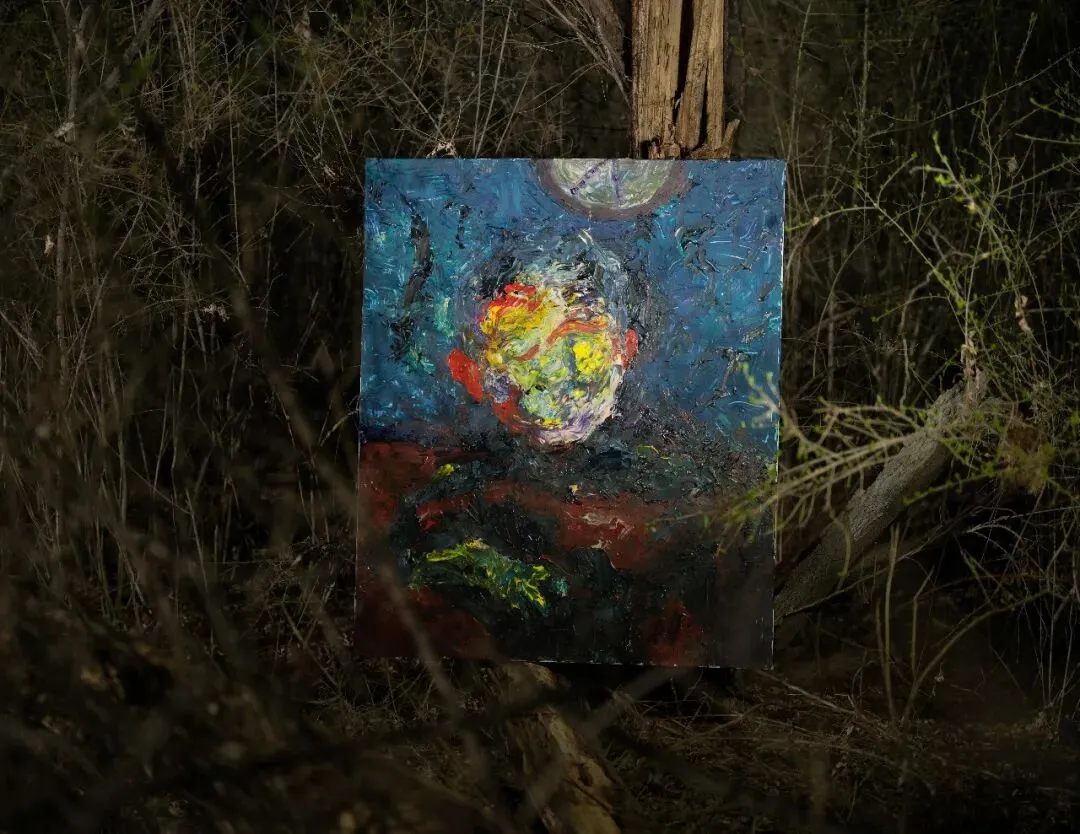
没有时间概念
No Sense of Time
2026
Oil on canvas, acrylic, cyanotype solution, spray paint
100x120 cm
但即使是最没有存在感的人,也躲不过《监督》——那张总躲在门后偷看的脸,以各种形式出现在各种场合,悄无声息地行至巨幕边缘,理所当然地挤破两个截然不同的空间。《嘿,我长大了》画的是一个试图膨胀、叫喊着宣称自己已成为世界一部分的漂浮幽灵。与孩童天真的叫嚣相对的是一个总想《金盆洗手》的男性,身处那架巨大而无法停歇的体制机器之中,他既沦为臃肿与腐败的一部分,又心怀恐惧,渴望安稳地全身而退。
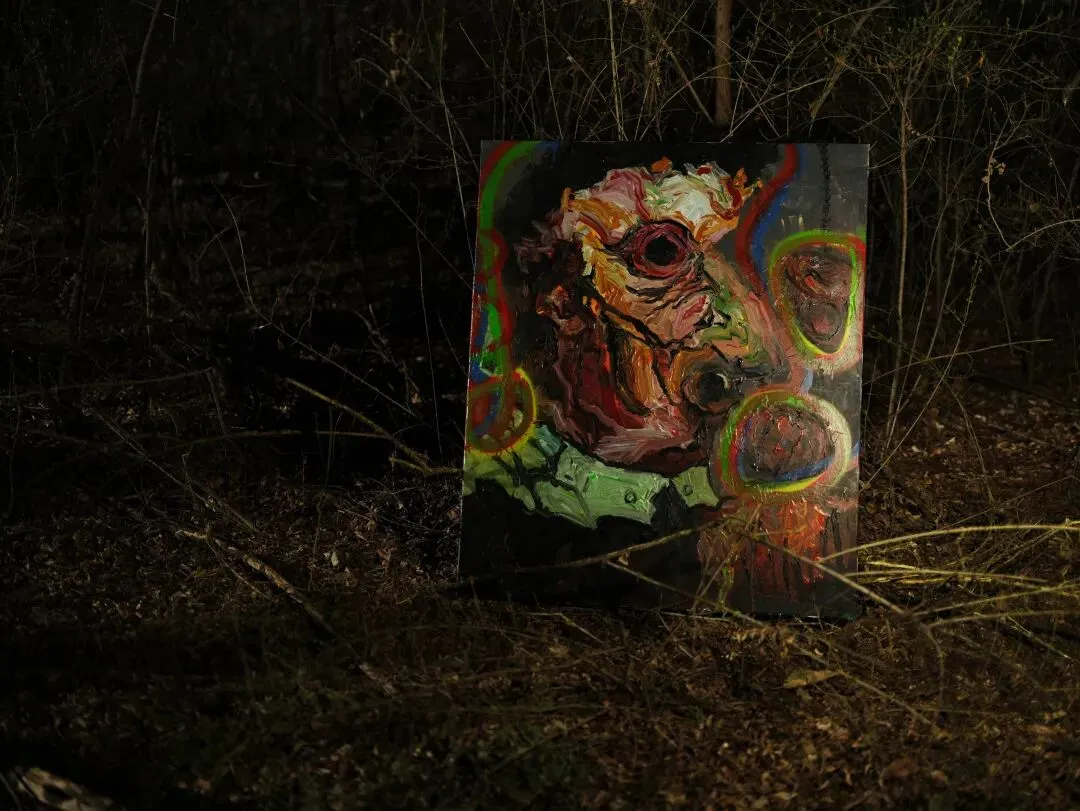
我长大了
Hey,I've Grown Up
2026
Oil on canvas, acrylic, cyanotype solution, spray paint
100x120 cm
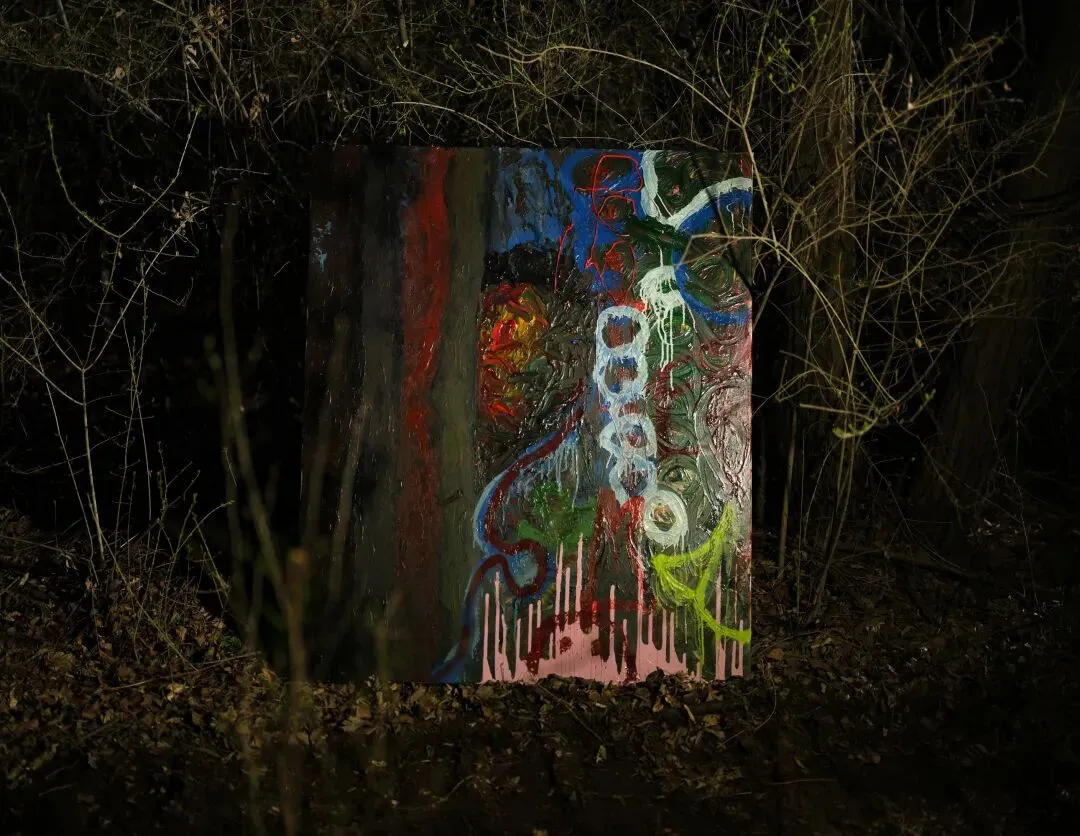
监督
Bing Watched
2026
Oil on canvas, acrylic, cyanotype solution, spray paint
100x120 cm
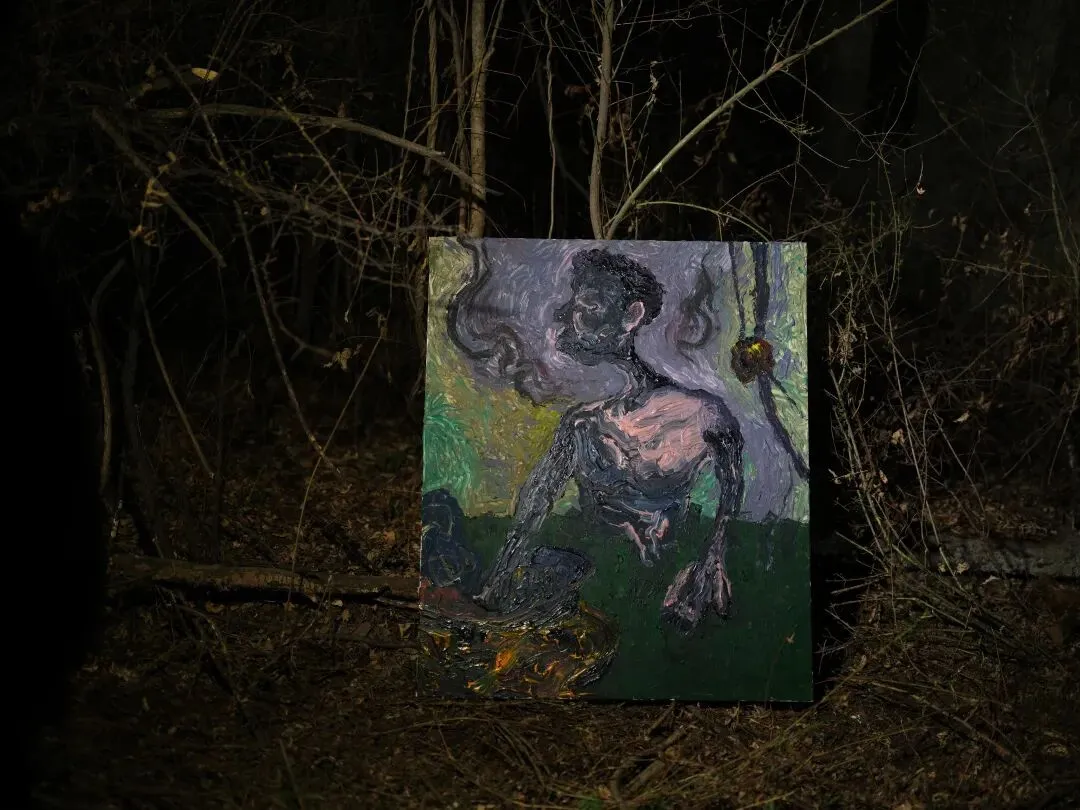
金盆洗手
Go Straight
2026
Oil on canvas, acrylic, cyanotype solution, spray paint
100x120 cm
二十五年的生命记忆与对未来的不安揣测,被压缩成五层意象。每一笔都是童年铁花的余烬,也是成人世界里无法理清的荒诞现实。倘若无法跳出这二十五年的循环,倘若再次投身于那场停滞在时间边缘的游戏,自己将变成怎样的人?——这是艺术家反复叩问自己的课题,也是他内心最深的恐惧。
Chapter 2
A Lifetime at Twenty-Five
This is a visual diary. The artist Wang Churan, from a child’s perspective, records what he calls his “twenty‑five years of a lifetime.”
The earliestWorldwas the flying sparks of the steel mill. They were the exhilaration and revelry embedded in several generations of Northeastern memory, and also the strange spectacle this child captured in his first gaze—meteors of fire falling everywhere, like a firework display that would never end. Later, he found himself increasingly at odds with everything around him; he was constantly admonished for havingNo Sense of Time. He could not concentrate, nor could he force himself to try any longer. Instead, he felt like a powerless, faceless presence.
However, even the most invisible person cannot escape Being Watched—that face always peeking from behind the door, appearing in different guises and places, silently advancing to the edge of the giant screen, and naturally breaking through two entirely different spaces. Hey, I’ve Grown Updepicts a drifting specter that tries to swell up and shout that it has already become part of the world. In contrast to the child’s naive bravado stands a man who always wants to Go Straight.Trapped within that immense, unceasing machinery of the system, he becomes both part of its bloated, corrupt apparatus and someone who secretly fears for his own safety and longs for a quiet exit.
In Wang's practice, twenty‑five years of memories and anxious speculations about the future are compressed into five layers of imagery. Each brushstroke is both a dying ember of childhood sparks and the absurdity of an adult world that cannot be untangled. He refuses to perpetuate his hometown's strange cycles—extraction, abandonment, quiet devastation—and yearns for a world of his own. "If I cannot break out of this cycle, if I throw myself once again into that game suspended on the edge of time, what kind of person will I become?" This question is the artist's deepest fear, and also the fuel for his determination to break free.
Swipe to see more
Chapter 3
乐园
决定做全职艺术家之后,王楚然曾带着自己的作品四处求教,换来的却是“画得跟屎一样”、“不适合做艺术家”、“把世界想得太简单了”。仿佛有一道隐形的门槛横亘在前——艺术在许多人眼中,是与辈分、资历深度绑定的词汇,他的年轻不仅微不足道,甚至是一种轻浮和冒犯。
而当他作为观众进入艺术中心和画廊想要和策展人讨论为什么选择一些作品、标准是什么时,也被更多理解为抬杠和没有家教。凝视并非只在话语中,它还来自权力的另一端,来自那些早已被内化、却从未被言明的规则。
挑战,似乎是艺术家王楚然的本能。
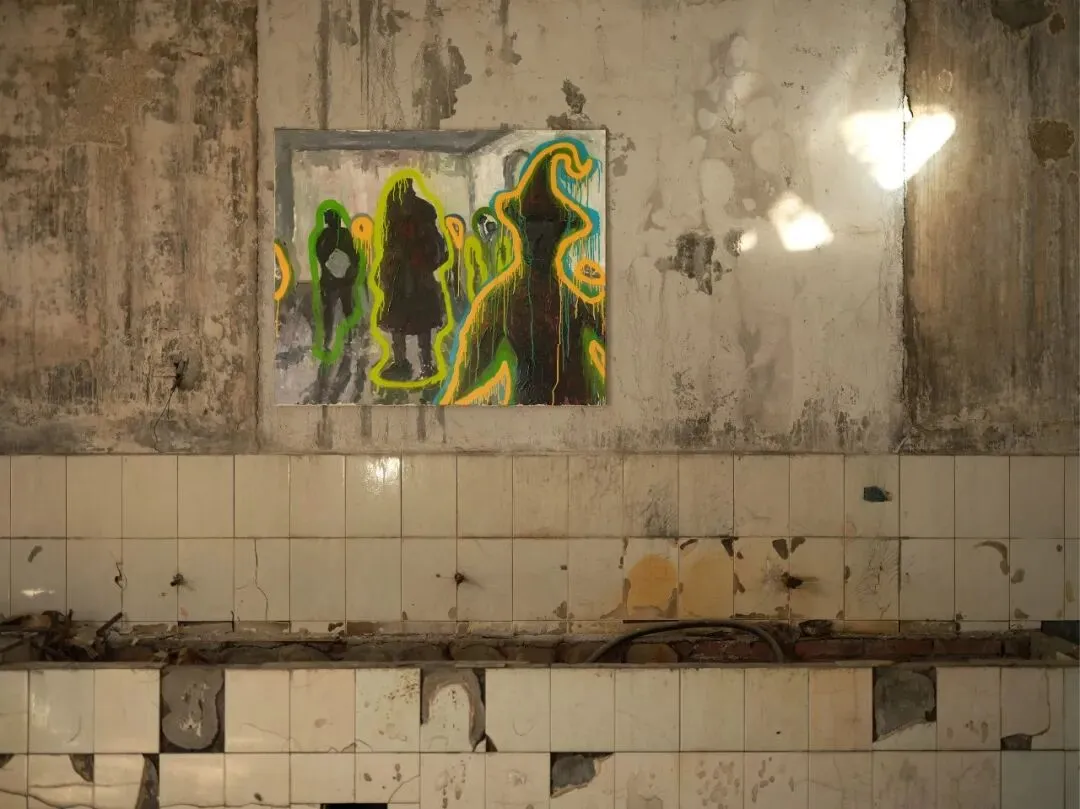
乐园5
Playground 5
2026
Oil on canvas, acrylic,, spray paint
100x120 cm
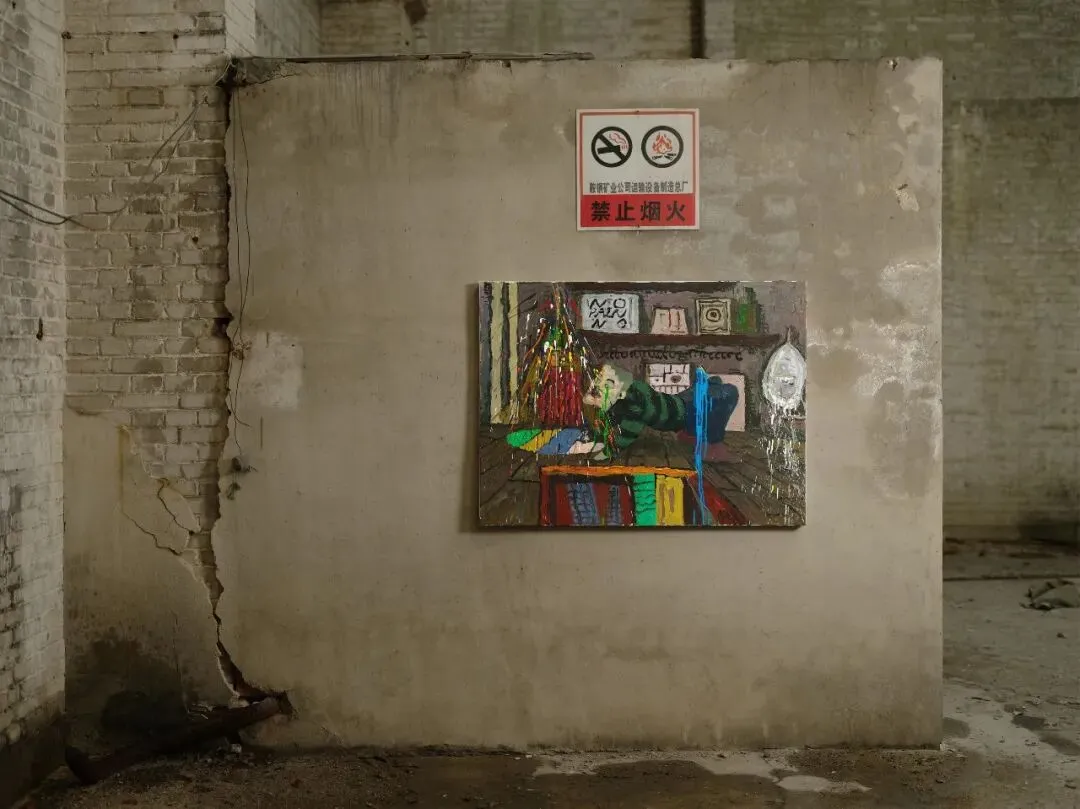
乐园 3
Playground 3
2025
Oil on canvas, acrylic, spray paint, glycerin
100x120 cm
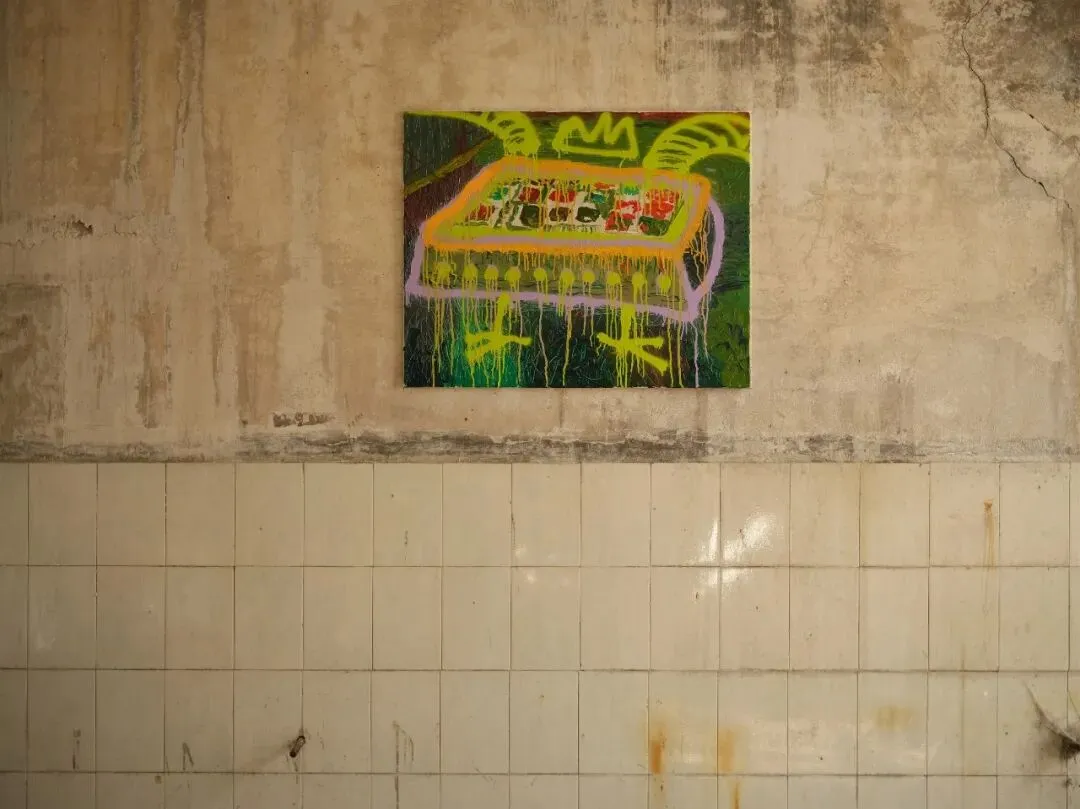
乐园 6
Playground 6
2025
Oil on canvas, acrylic, spray paint, glycerin
80x100 cm
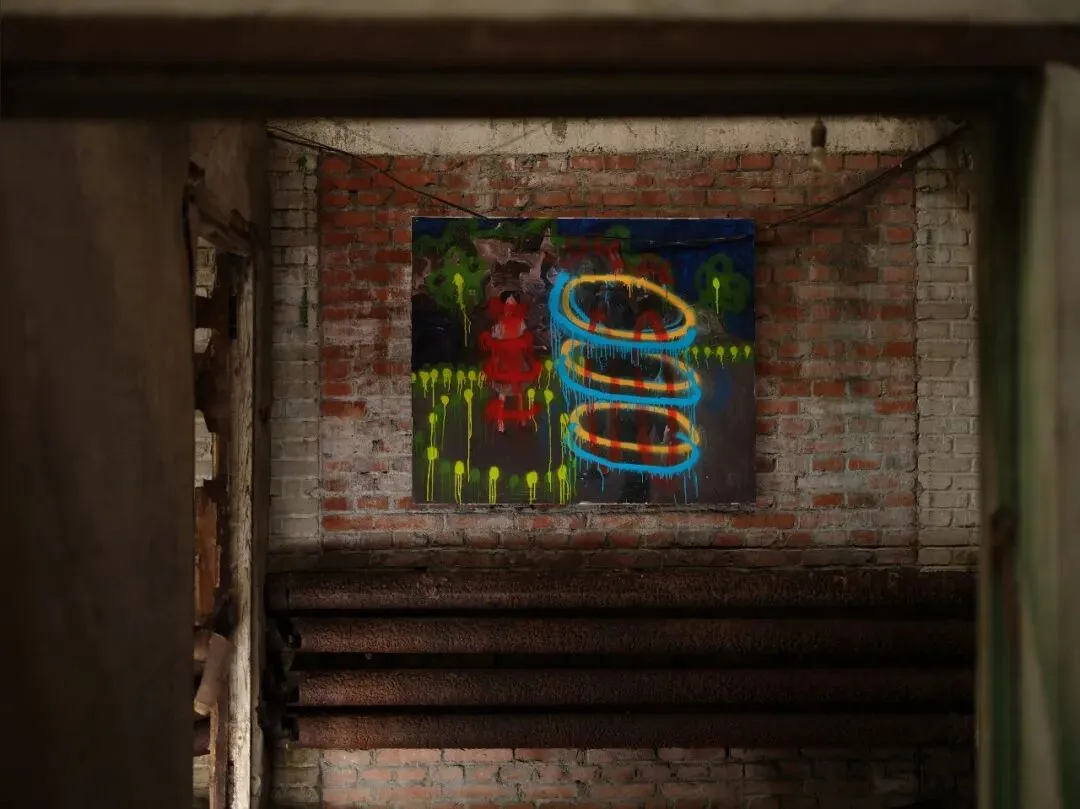
乐园 4
Playground 4
2025
Oil on canvas, acrylic, spray paint, glycerin
80x100 cm
在《乐园》系列中,王楚然用高饱和的荧光色描摹日常碎片:停车场灰扑扑的防水罩、公园角落的假山石、地铁里涌动的人群、咖啡馆里高谈阔论的吹牛专家、经不起凝视的伟人肖像,垃圾堆中的鬼脸,这些细节被鲜艳色彩定格,远看热闹华丽,近看荒诞不经。
Chapter 3
Playground
After deciding to become a full‑time artist, Wang Churan sought advice on his work from various quarters, only to be told that his paintings were “like shit,” that he was “unsuited to being an artist,” and that he “thought the world far too simple.” It was as if an invisible threshold lay before him. For many, art is deeply bound to seniority and credentials, and his youth was not merely negligible but read as frivolity, even insolence.
When he entered art centers and galleries as an audience and tried to ask curators why certain works were selected and what criteria governed those choices, he was likewise dismissed as combative and ill‑mannered. The gaze does not reside in words alone. It issues from the other end of power, from internalized yet never‑articulated rules.
To challenge seems to be this young man’s instinct.
In the Playgroundseries,Wang Churandeploys high‑saturationfluorescent colors to render everyday fragments: the dustywaterproof covers in parking lots, the hollow artificial rockeriesin forgotten corners of parks, the surging crowds in the subway, the braggarts holding forth in cafés, the portraits of great men that cannot withstand scrutiny, the grimaces amid heaps of garbage. These details are frozen in vivid hues—gaudy and festive from a distance, absurd up close.
Swipe to see more
Chapter 4
余烬
在构建个人艺术语言方面,王楚然对材料、时间、肉身以及空间的关系十分敏感。
在《余烬》(The Burning Negotiation)的创作过程中,他先是花1-2天时间徘徊在画布面前,以身体为轴 ,将豆油、花生油、液体丙烯、胶性丙烯、油画颜料、松节油、咖啡粉、甘油、塑料制品、纸胶带、透明胶带、水泥、大米、黑米、核桃仁、洗手液、润滑剂、墨水、墨汁、烟草、碎纸屑等所有他能够接触到的材料一层层泼洒向画面。
在这个阶段,艺术家的状态接近于波洛克在20世纪40年代开创的抽象表现主义“滴画”技法,绘画本身成为一种充满动态的“事件”和“行动”,是艺术家自我赋权的过程。但这种“自我赋权”在“自我过剩”的当下来看,更多会被理解为虚无和矫叹。
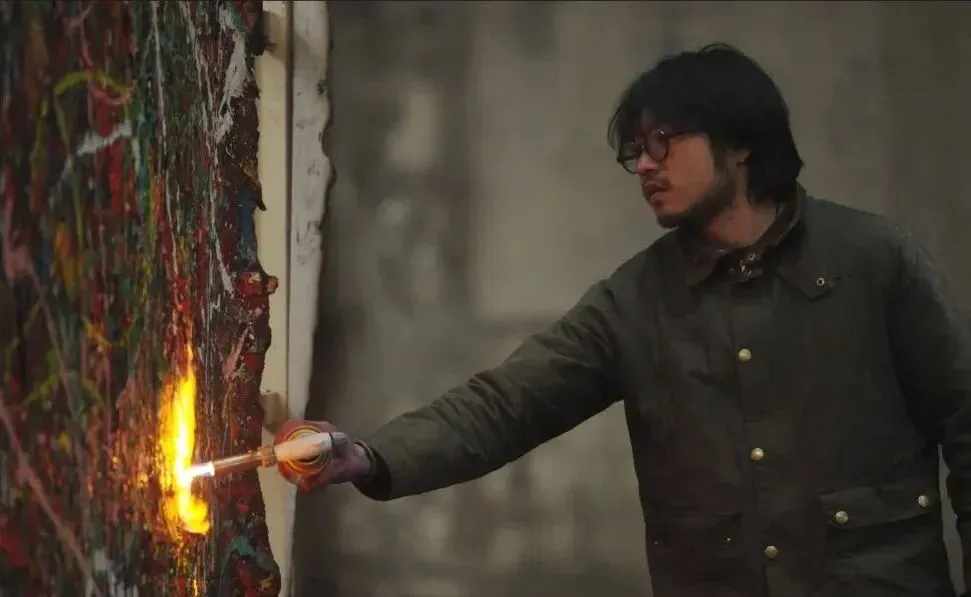
于是在创作的第二阶段,王楚然引入了一个暴烈的“他者——火。在鞍山的故事里,火从来不是温和的:钢厂的高炉、飞溅的铁花、污染与灼伤——火是过往殖民掠夺的工具,是环境破坏的源头,更是工人身体上无法磨灭的印记。艺术家童年记忆中的铁花是一场永不结束的烟花,但那烟花背后是榨取与牺牲。
如何理解和观看这种牺牲?带着幸存者的侥幸还是旁观者的冷漠?
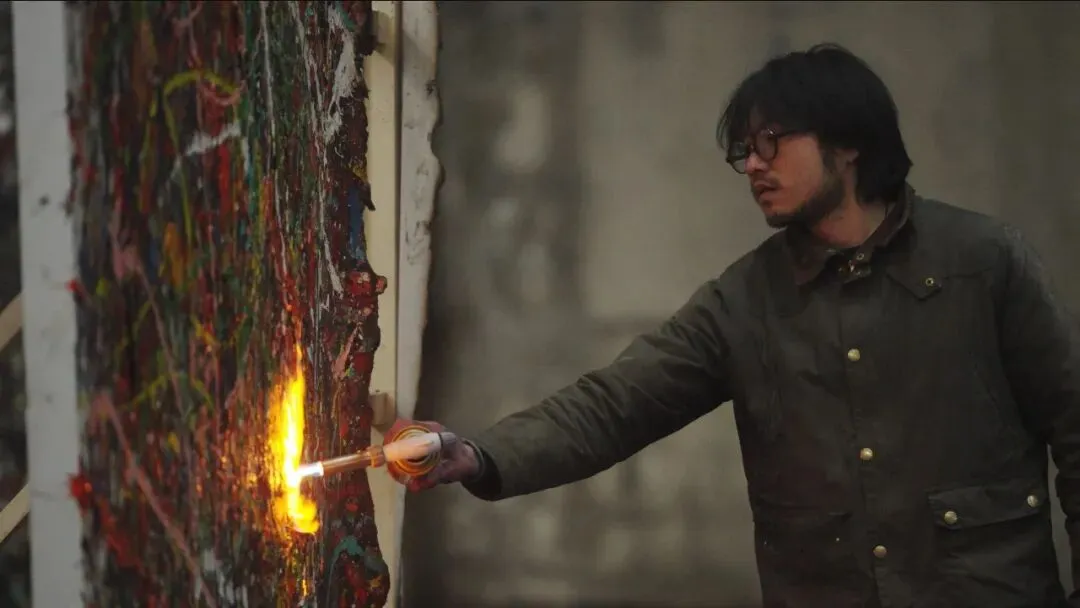
王楚然选择让火焰直接舔舐画布,颜料碳化、绷布卷曲、图像溃散——火作为历史的幽灵重返现场,烧穿个体抒情的薄纱,暴露出宏大叙事里被反复掩埋的痛觉神经。也唯有烈火能让艺术家本人亲身经历祖辈们所经受的不可控的、危险的、灼热的暴力。
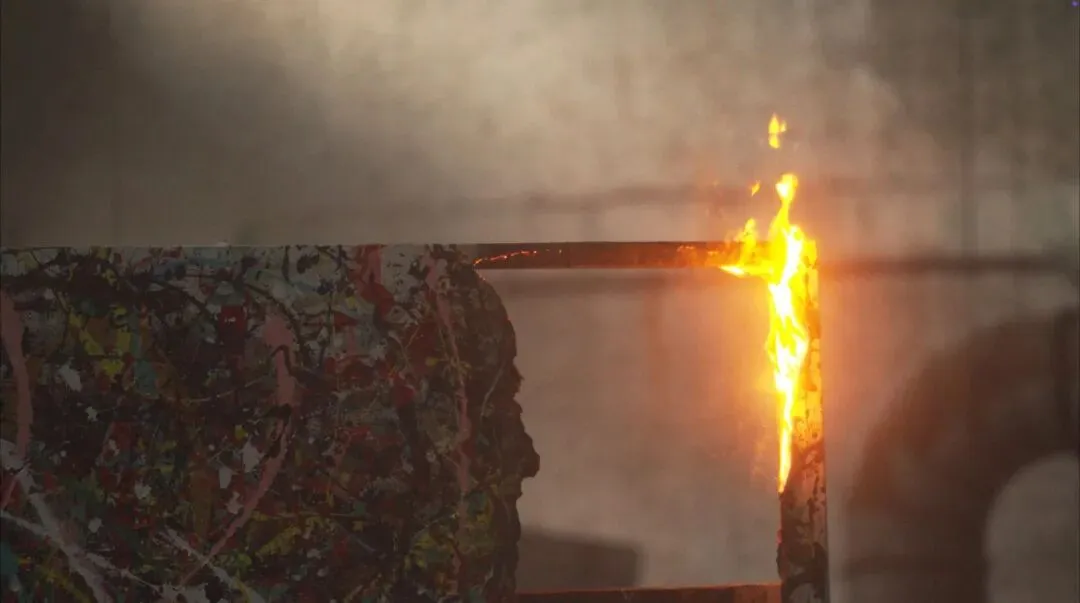
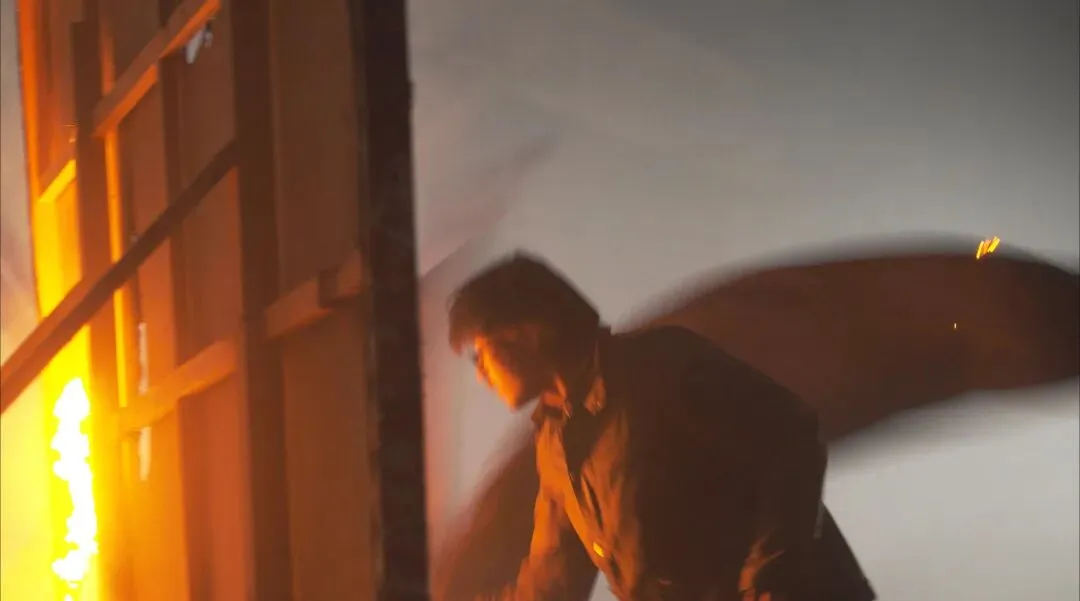
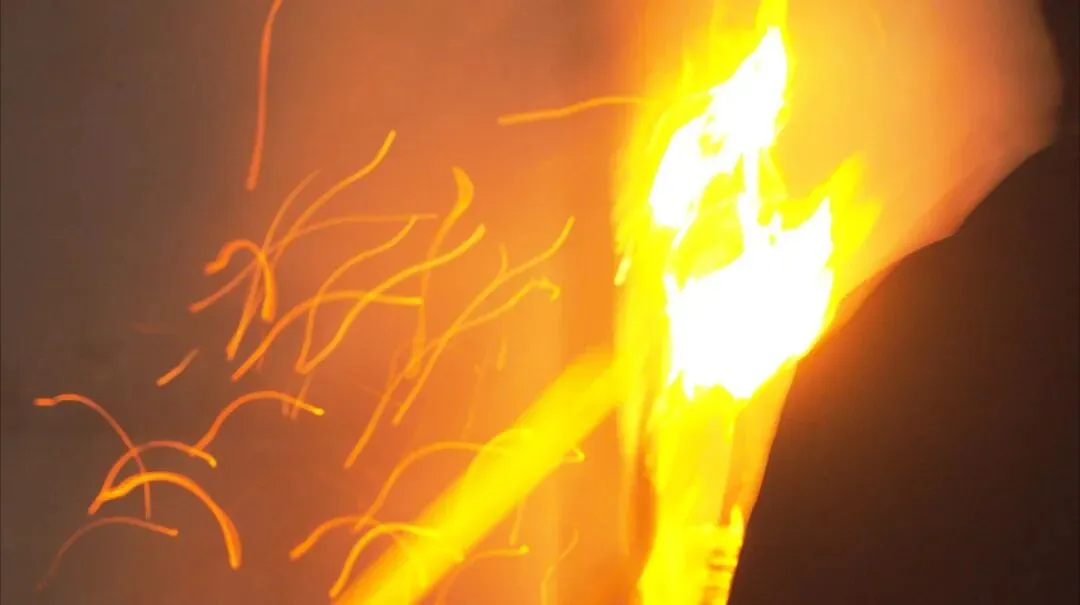
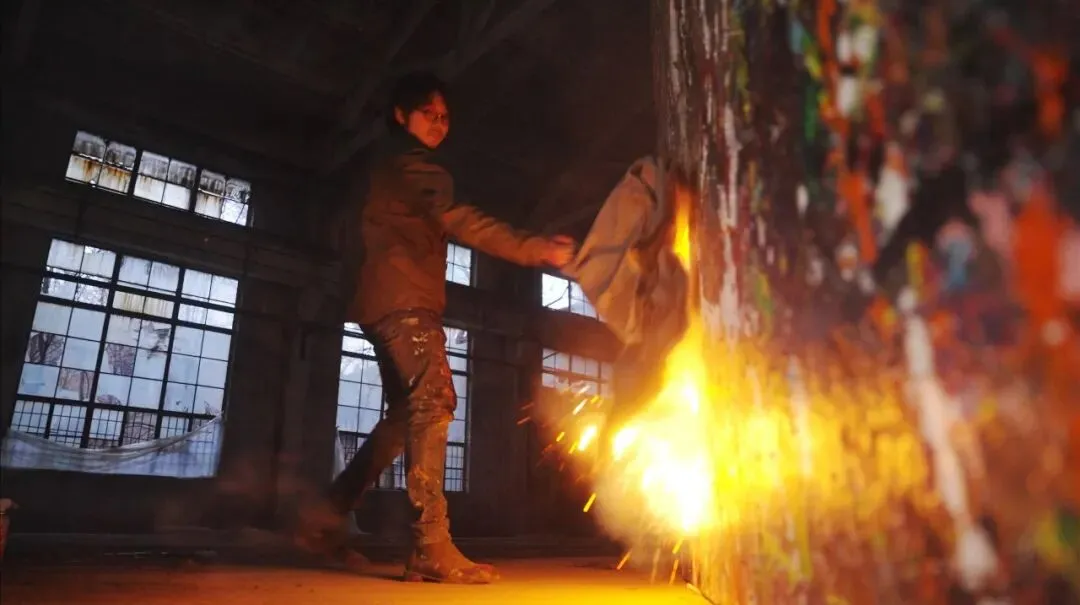
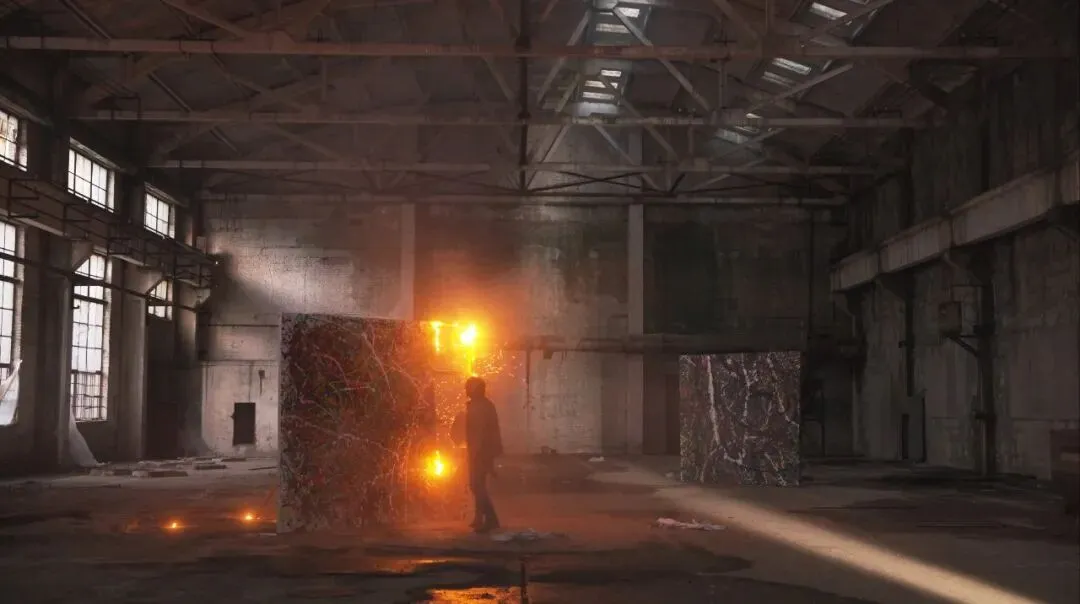
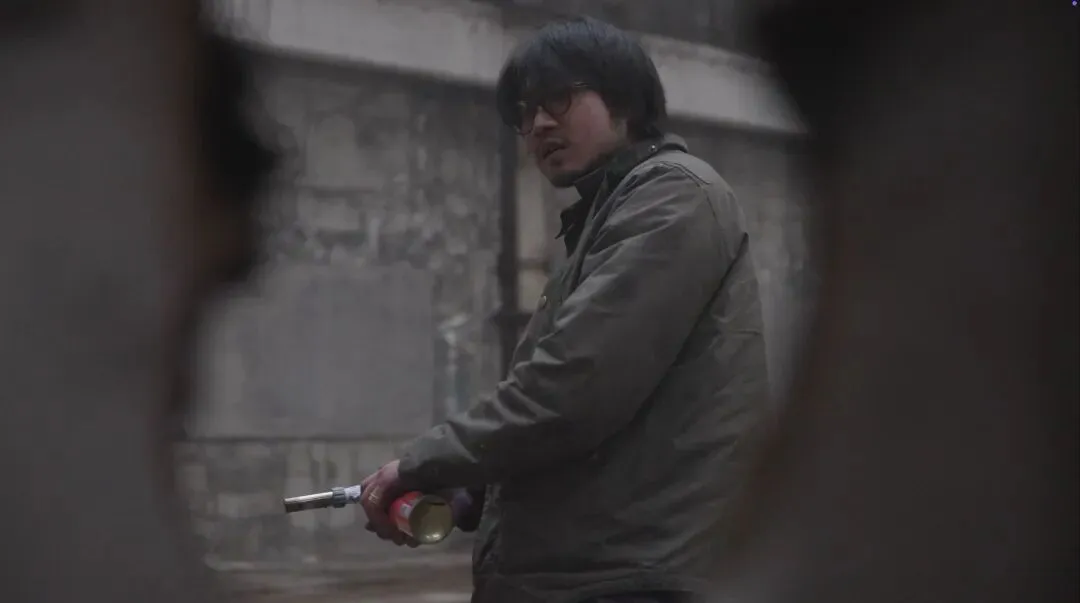
余烬 创作现场|The Burning Negotiation Creation Site
这不再是绘画,而是谈判:与失控谈判,与毁灭谈判,与那个始终凝视着每一个人的巨大不可抗力谈判。
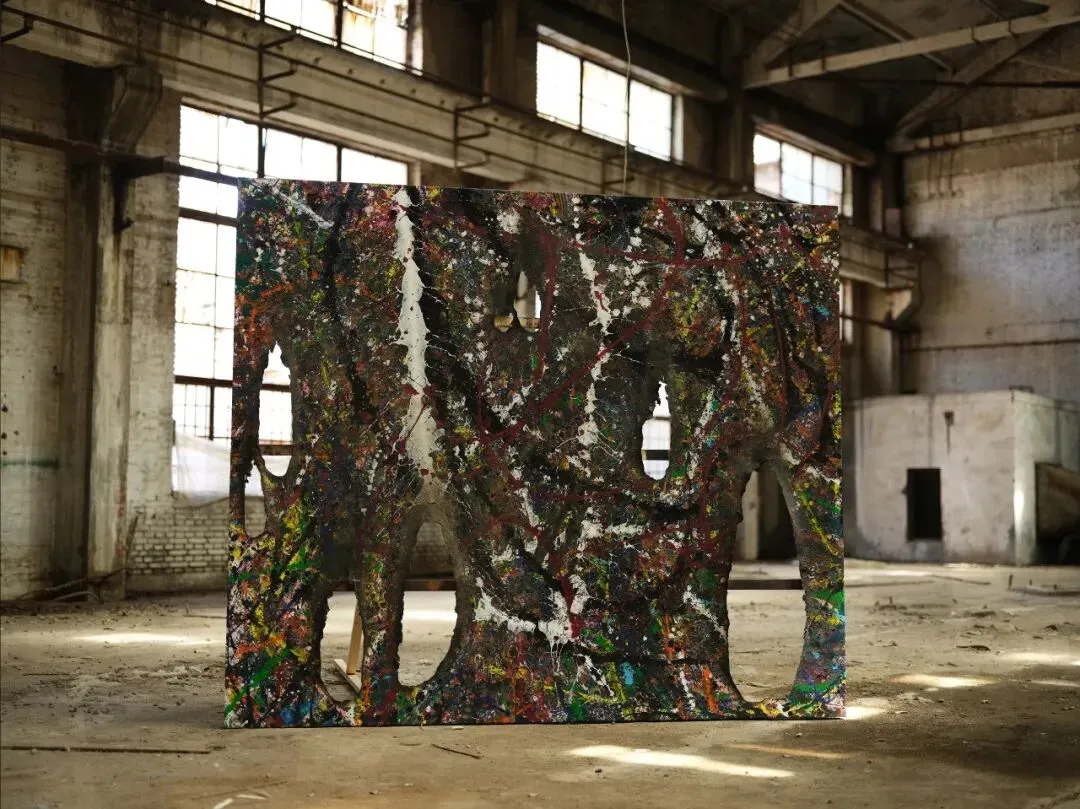
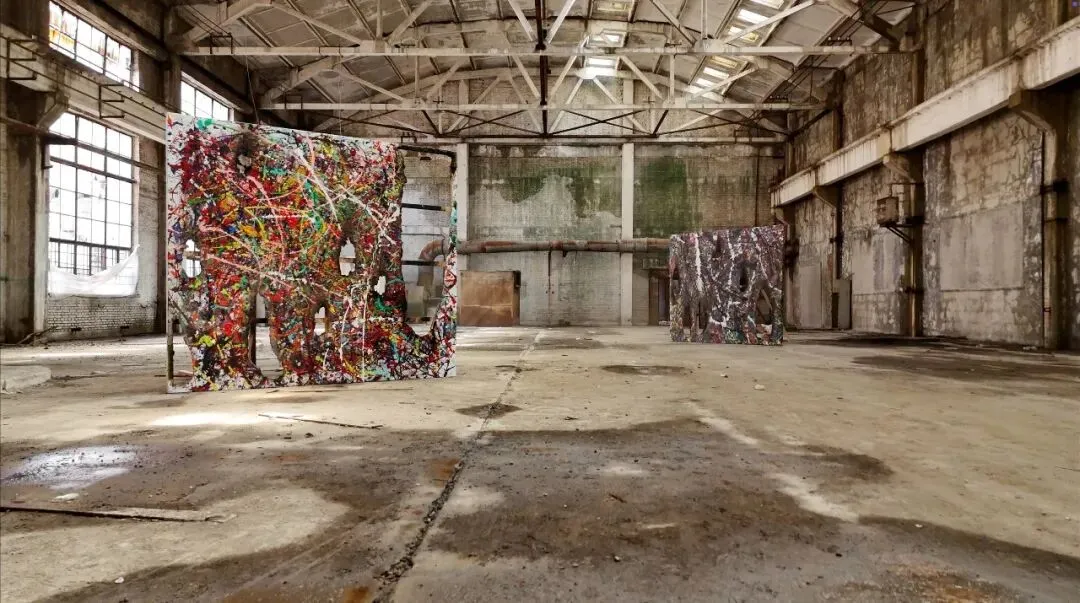
余烬
The Burning Negotiation
2025
Oil on canvas, acrylic, glycerin, coffee liquid&powder, cyanotype solution, grains, waste plastic, washi tape, soil, hand sanitizer
240x280 cmChapter 4
In the development of his personal artistic language, Wang Churan exhibits a keen sensitivity to the relationships among material, time, the body, and space. During the creation of The Burning Negotiation, he first spent one to two days lingering before the canvas. Then, using his body as an axis, he splashed onto the picture plane, layer upon layer, every material he could lay his hands on: soybean oil, peanut oil, fluid acrylic, gel medium, oil paint, turpentine, coffee powder, glycerin, plastic objects, paper tape, transparent adhesive tape, cement, rice, black rice, walnut kernels, hand soap, lubricant, drawing ink, Chinese ink, tobacco, shredded paper—an exhaustive inventory of the disposable and the edible, the viscous and the granular.
In this phase, the artist’s mode of working approximates the “drip painting” technique that Pollock pioneered in the 1940s, in which painting itself becomes a dynamic “event” and “action”—a process of self‑empowerment for the artist. Yet, in the contemporary condition of an “excess of the self,” such self‑empowerment is more often than not interpreted as nihilistic posturing and hollow lamentation.
Thus, the second phase of the process begins. Wang Churanintroduces a violent “Other”: fire. In the story of Anshan, fire has never been benign. The blast furnaces of the steel mill, the flying sparks, the pollution and the burns—fire was the tool of colonial extraction, the source of environmental destruction, and above all, an indelible mark etched into the bodies of the workers. The sparks in the artist’s childhood memory were a firework display that would never end, but behind that display lay extraction and sacrifice.
How is one to comprehend and behold such sacrifice? With the complacency of a survivor, or with the detachment of a bystander?
Wang chooses to let the flame lick the canvas directly. The pigment carbonizes, the stretcher curls, the image disintegrates. Fire, as the specter of history, returns to the scene, burning through the gossamer veil of individual lyricism and exposing the nerve of pain repeatedly buried beneath grand narratives. Only the fire itself allows the artist to experience firsthand the uncontrollable, perilous, searing violence that his forebears endured.
This is no longer painting. It is negotiation. Negotiation with loss of control, negotiation with annihilation, negotiation with that immense, unyielding force that has always gazed upon every single one of us.
Swipe to see more
Chapter 5
洞穴
皇家艺术学院学习期间,王楚然曾在教授们的带领下参与了以加沙作为建设场地的城市设计课题研究,探索战争中的人们如何生活。这是他第一次如此近距离地意识到:在汹涌的国际政治浪潮中,普通人的肉身、情感与生计,可以被不可抗力轻易碾碎。加沙的废墟、难民营中的孩童、被封锁的医院——这些画面不再是新闻里的遥远符号,而是真真切切地钉入他的感知。
回国后,在与Masa Archive的协作中,他进一步接触到正在柬埔寨、越南、缅甸、赞比亚、坦桑尼亚等全球南方地区发生的故事。那里的人们同样被困在复杂的国际局势之中:大国博弈的棋盘、跨国公司对资源的榨取、后殖民时代的债务陷阱、气候危机的次生灾害……历史从未真正过去,它以更隐蔽的方式活在当下的每一次停水、断电、因外资撤离而失去的岗位、以及年轻人脸上的茫然里。
每一个人都身处这张网中,却几乎无人能够撼动它的结构。于是,一种深切的无力感开始蔓延,甚至演变为“政治抑郁”——人们不再愤怒,不再抗议,只是沉默地消耗着日常——担忧与焦虑不再催生行动,人们被困在一场看不见对手的战争中,连呐喊都找不到回音。
正是在这个时候,自我的“洞穴”变得极其重要。不是为了隔绝风浪,而是为了暂时离开政治噪音、离开数据轰炸、离开那些我们无法承担却又无法忽视的集体焦虑。进入洞穴,不是为了忘记世界,而是为了重新找回注视世界的距离。
对王楚然而言,鞍山就是他的洞穴。
那座被钢厂塑造又被钢厂遗弃的城市,承载着他童年的铁花、父辈的沉默、以及被多重历史力量反复碾压的面孔。他清楚地知道自己的来时路:那些殖民掠夺的炉火、工业化时代的烟龙、下岗潮后的空置车间、以及漂浮在空气中的霉菌孢子。他也清楚地知道自己在全球版图中的位置——一个被榨取过、被透支过、然后被放置于转型期茫然中的具体坐标。这种自知并不能改变任何宏观格局,但它赋予了他一种稀缺的能力:真正地凝视深渊,而不被深渊吞没。
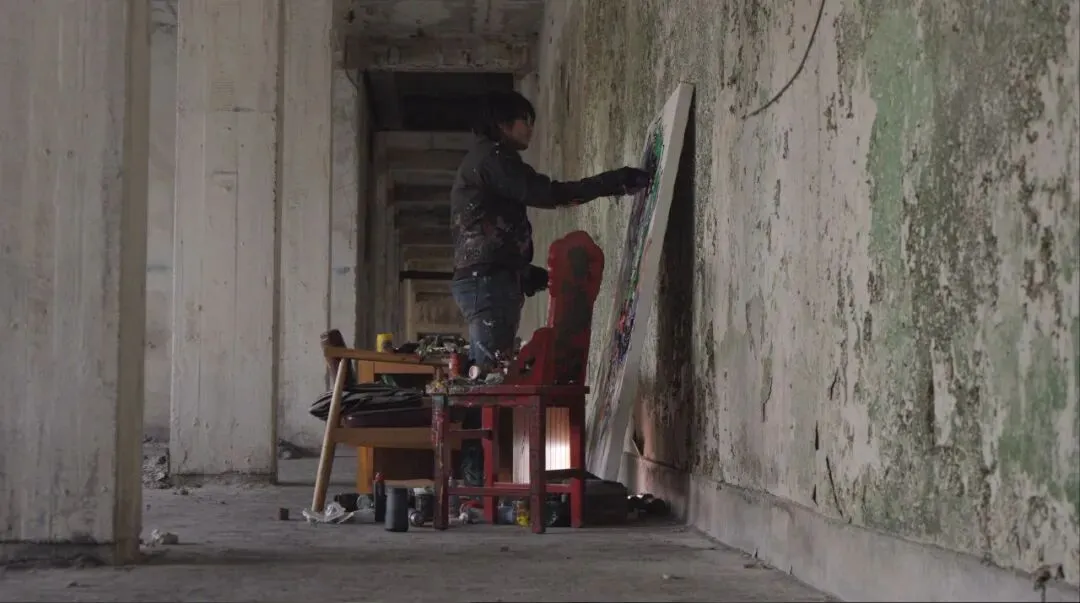
于是,他开始用画笔在洞穴中构造一个完全属于自己的世界。
这个世界的起点,有些出人意料——是小时候父母让他可以随意支取钱币的那只零钱罐。那只罐子没有锁,没有账本,没有任何“你应该如何花费”的规训。它像一个微型的、绝对安全的洞穴,里面装着几枚硬币、几张皱巴巴的纸币,以及一个孩子对“自由”最初的、最具体的想象。从那里开始,王楚然学会了信任自己的选择——哪怕那些选择只是买一根冰棍,或攒下一枚硬币等待某个未知的用途。那只零钱罐教会他的,不是金钱的价值,而是“我可以决定”的滋味。
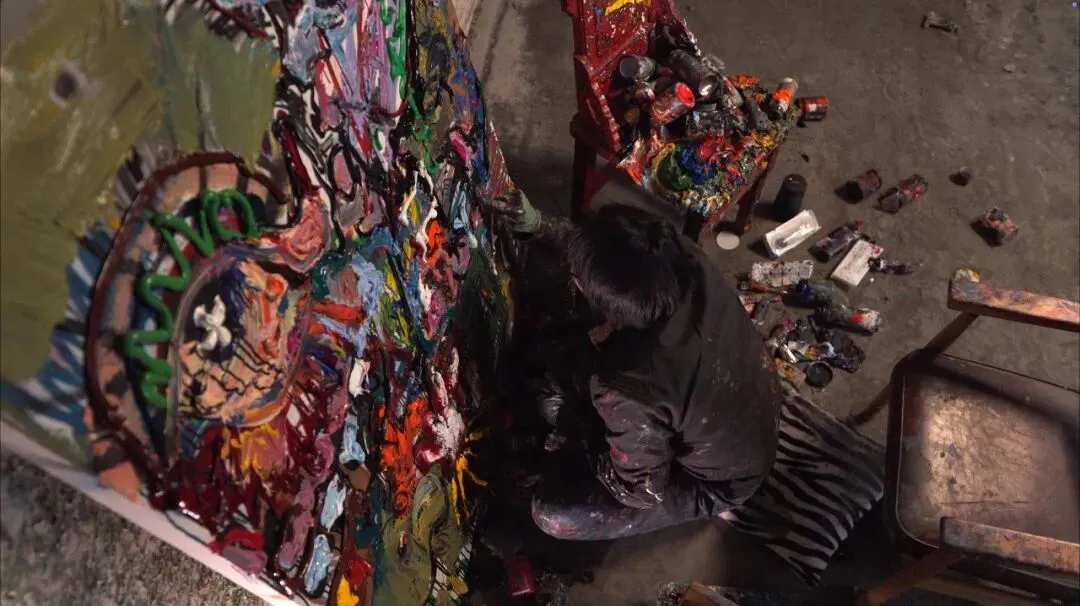
如今,那只罐子已经消失了,但它的结构留了下来。在《洞穴》系列画作中,大部分作品由抽象的色块堆叠而成,颜料不再仅仅是色彩的载体,而变成了一种更具物质性的信息——厚重处如凝固的岩浆,轻薄处如飘浮的灰尘。画面上没有传统的视觉中心,没有“主角”,没有那条引导目光从一个焦点滑向另一个焦点的经典透视线。相反,目光在画布上游移、徘徊、停顿、再出发,仿佛一个在暗室中摸索墙壁的人,永远找不到一个可以安放全部注意力的支点。
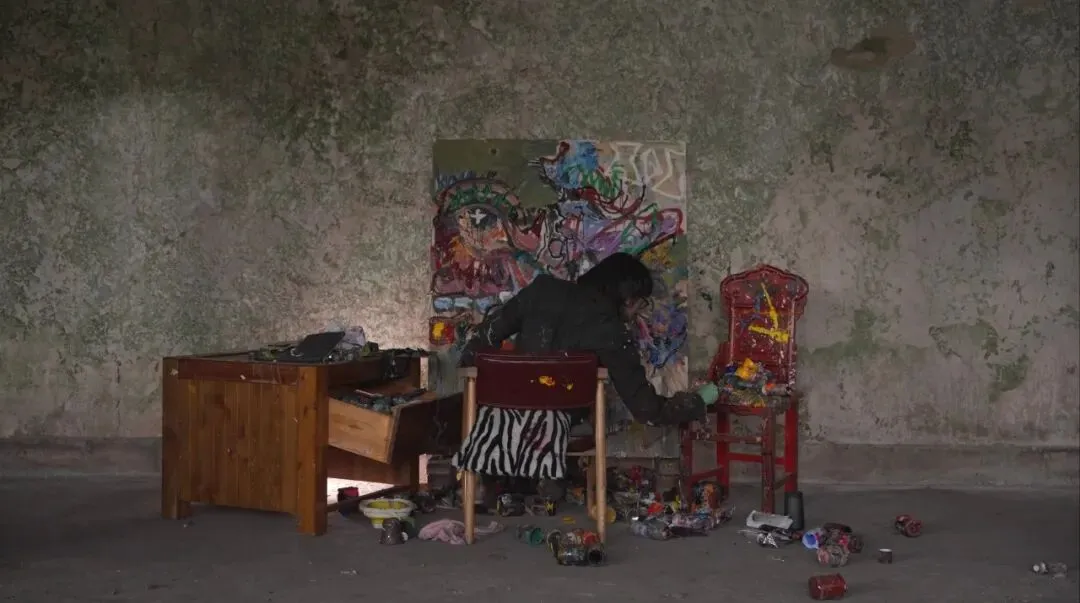
这正是散点透视的现代变奏,它取消了那个至高无上的、唯一正确的观看角度,从而也取消了“中心”对“边缘”的绝对统治。画中的每一块色斑、每一条刮痕、每一次颜料的堆积与剥落,都获得了一样的权重。它们共存、叠加、互相覆盖又互相暴露,像极了一个人的记忆——没有哪个片段是绝对的主角,也没有哪个细节可以轻易被遗忘。
没有视觉中心,在某种意义上,也是一种拒绝。拒绝向任何人证明自己作为艺术家的“合法性”,拒绝迎合外部的审美标准或权力话语,拒绝把自己塞进那个“你必须有一个鲜明的、可被快速识别的个人风格”的市场公式。而是回到一个更朴素、也更原始的起点。
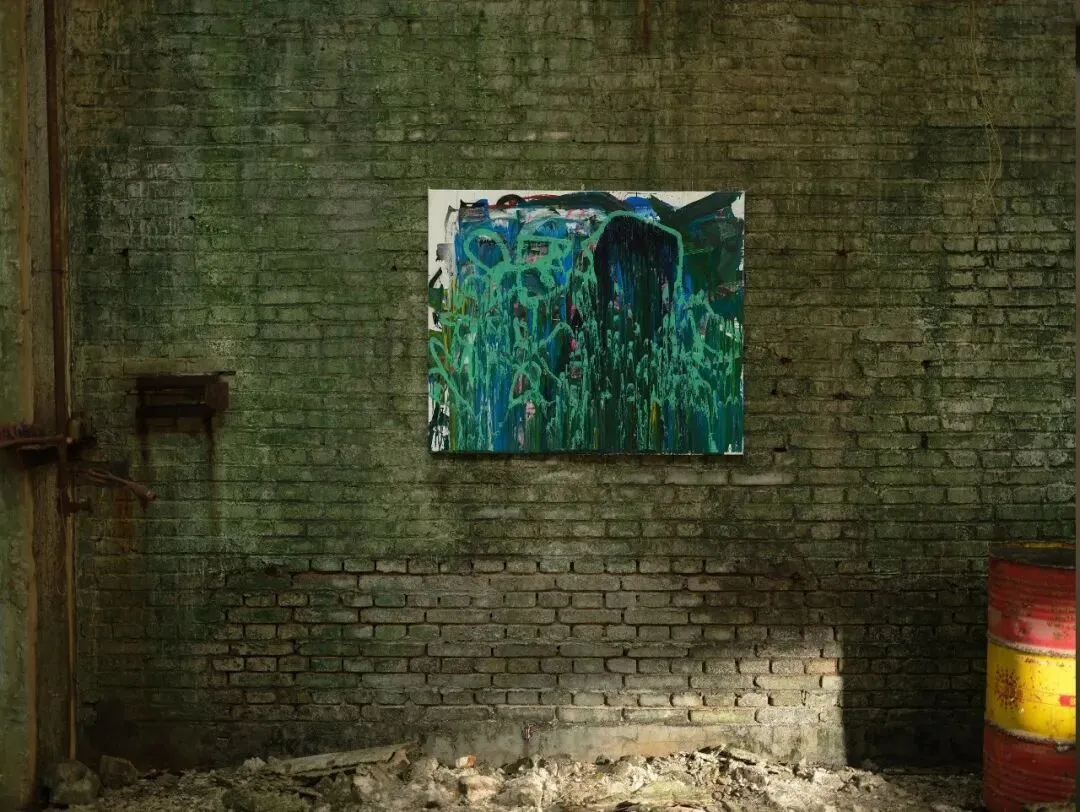
洞穴 3
The Cave3
2026
Oil on canvas, acrylic, spray paint, glycerin
100x120 cm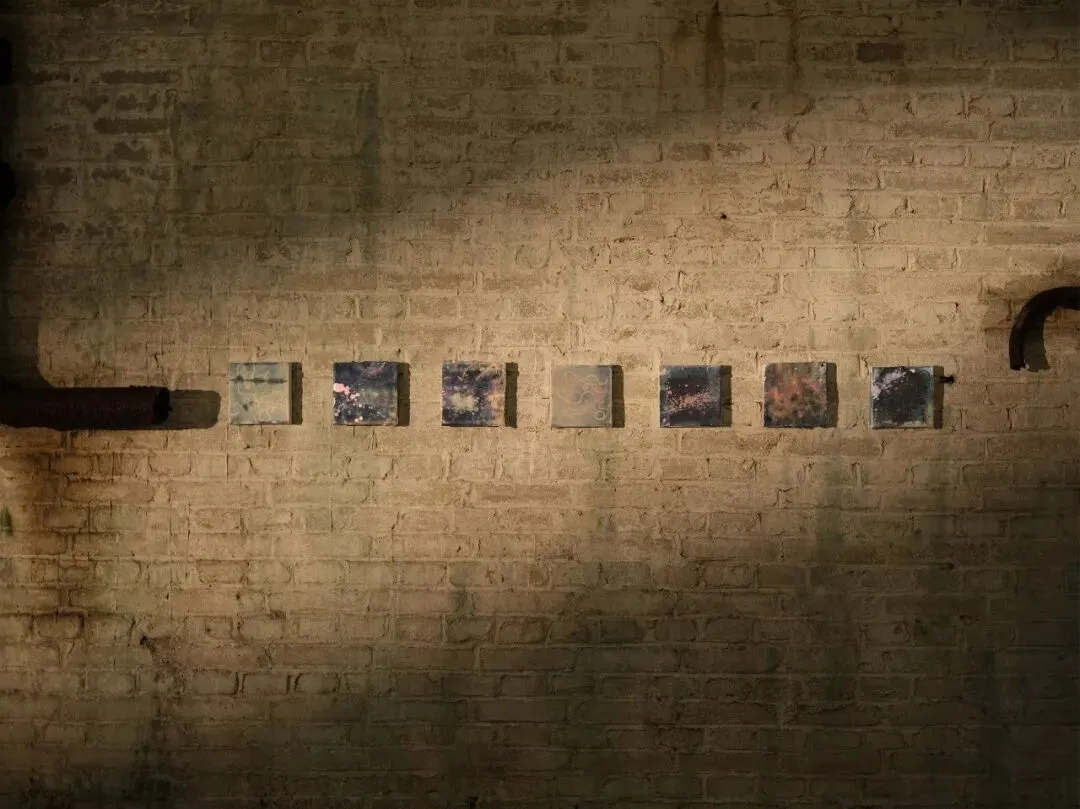
洞穴 组画
The Cave Group
2025
布面丙烯、蓝晒液、肌理膏、纸本、墨水
Acrylic on canvas, cyanotype solution, texture paste, ink
15x15 cm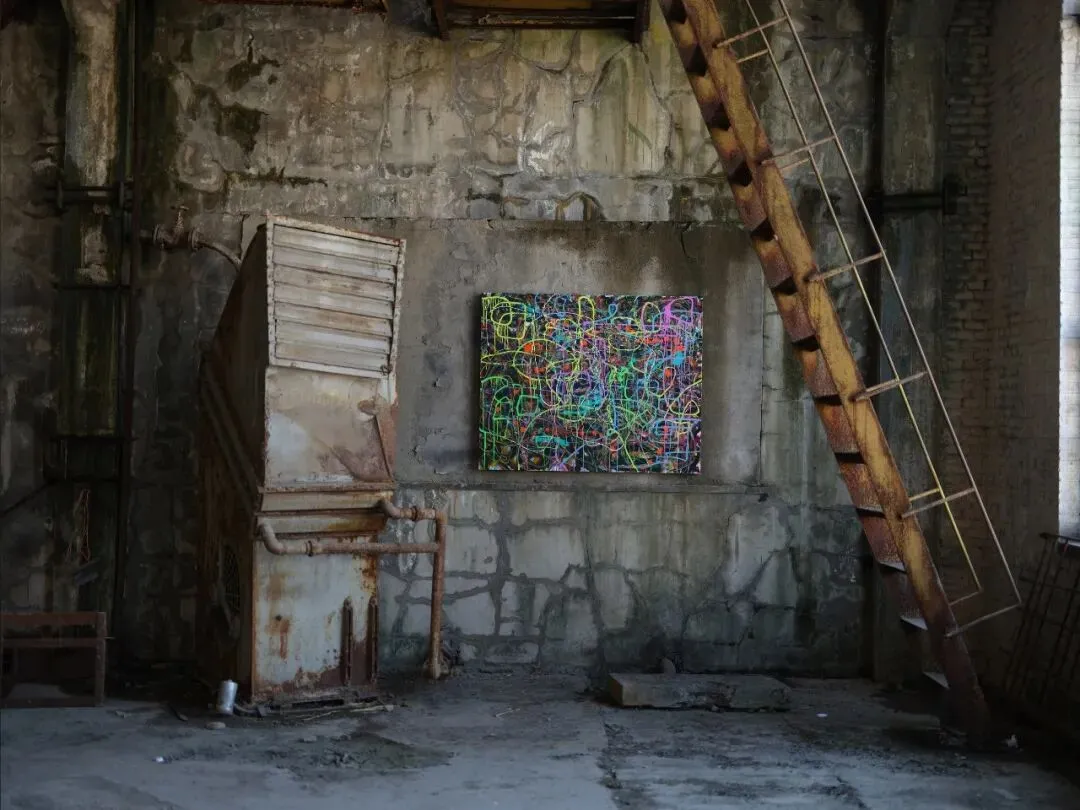
洞穴 4
The Cave 4
2025
Oil on canvas, acrylic, spray paint
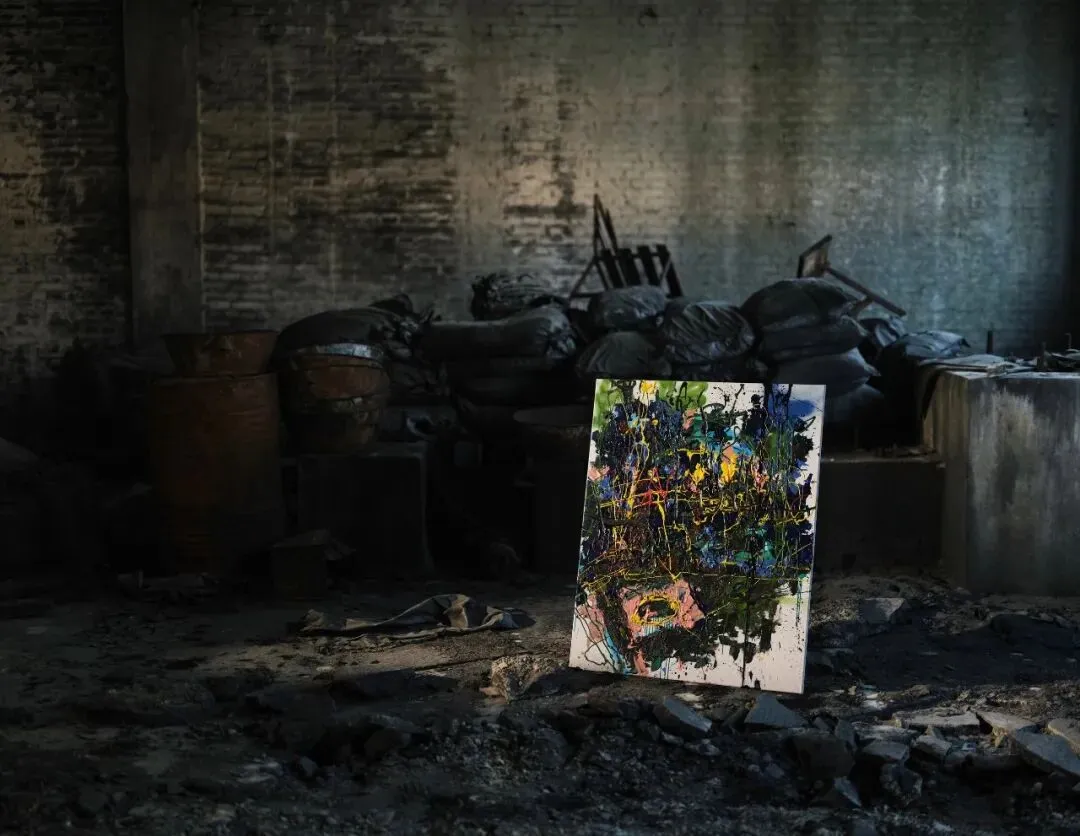 下班时间
下班时间
Time For Break
2025
Oil on canvas, acrylic, glycerin
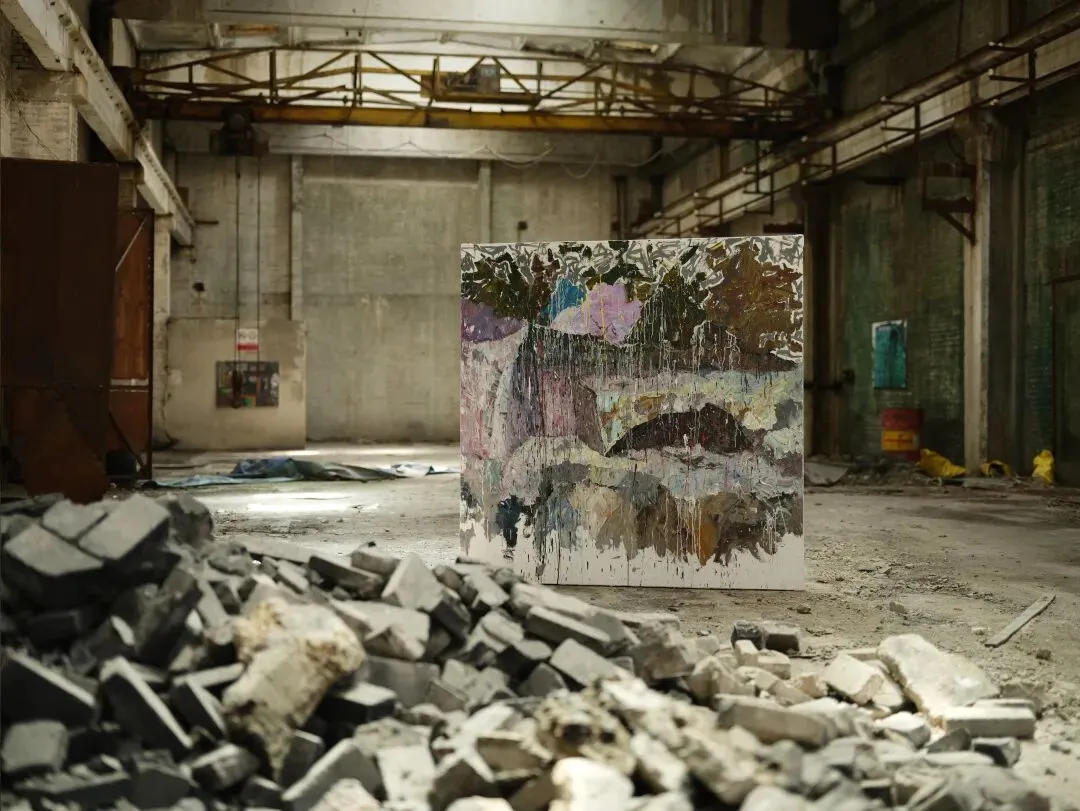
2025
Oil on canvas, acrylic
大约三万年前,在法国多尔多涅的拉斯科洞穴深处,早期智人在岩壁上画下了成群的野牛、鹿和神秘的抽象符号。那些画不出于“艺术”的自觉,而是出于一种更原始的、几乎无法抑制的冲动:在黑暗中留下痕迹。当炭笔和赭石将外部的恐惧转化为内部的秩序:猛兽可以被勾勒,风暴可以被命名,饥饿可以通过一场象征性的猎杀而被暂时驱赶时,人就获得了微弱但不可剥夺的主体性。
今天,猛兽变成了地缘政治的滚雷,风暴变成了全球经济的不确定性,饥饿变成了意义感的丧失。我们依然需要洞穴。不是为了退回到原始状态,而是为了在那个由自己亲手构建的、幽暗而安全的内部空间里,重新确认三件事:我看见什么。我站在哪里。我如何理解眼前的一切。
不以中心自居,也不以边缘自怜。这大概就是我们每个人的状态:不在中心,也不在边缘,而是在一个只属于自己的、可以随时进入又随时离开的洞穴里——既不统治,也不臣服;既不炫耀,也不隐藏;只是诚实地、耐心地,用炭笔和赭石,在黑暗中留下属于自己的那一道痕迹。这就是《洞穴》中的回音。
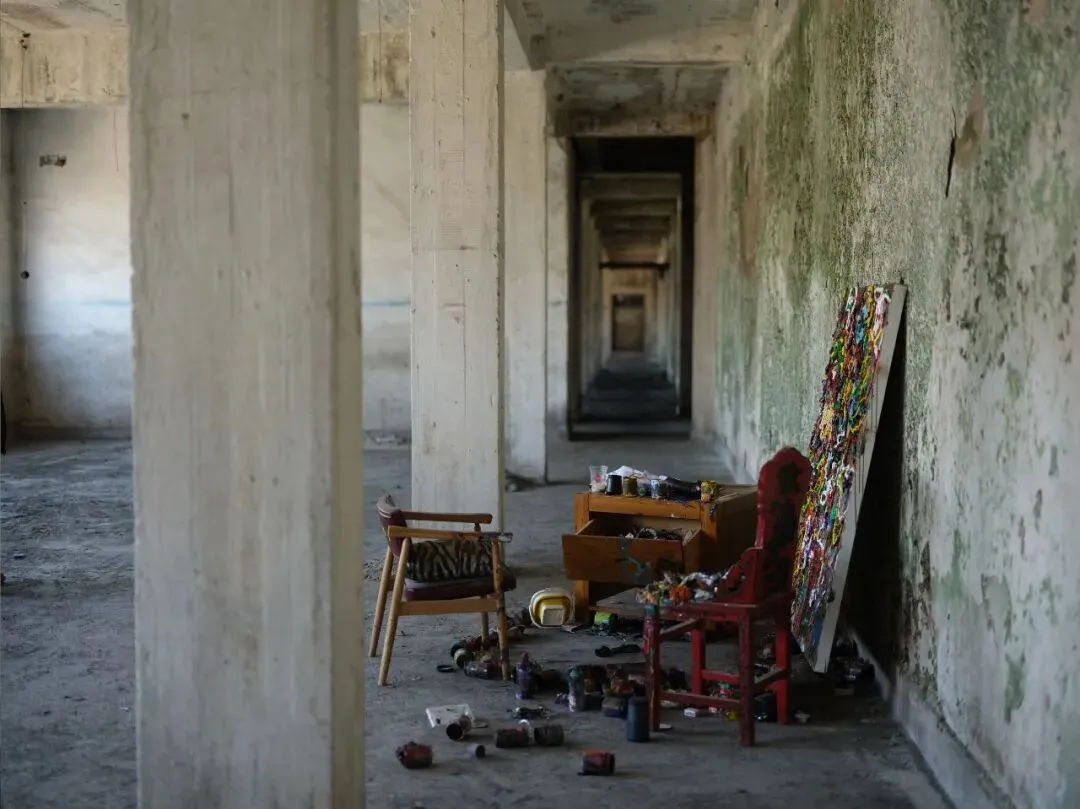
The Cave
During their studies at the Royal College of Art, Wang Churan—guided by urban design professors—joined a research project that used Gaza as a site for urban design, asking how people might live amid war. It was the first time Wang had come so close to understanding how easily ordinary people’s bodies, emotions, and livelihoods can be crushed by irresistible forces in the turbulent currents of international politics. The ruins of Gaza, the children in refugee camps, the besieged hospitals—these images were no longer distant symbols on the news; they pressed, viscerally, into perception.
After returning to China, while collaborating with Masa Archive, Wang encountered stories unfolding across the Global South—Cambodia,Vietnam,Myanmar, Zambia, Tanzania, and beyond. There, people are likewise trapped in complex geopolitical entanglements: the chessboard of great-power rivalry, the extraction of resources by multinational corporations, the debt traps of the postcolonial era, the secondary disasters of the climate crisis… History never truly passes; it lives on in subtler forms—in every interruption of water supply, every power outage, every job lost to the withdrawal of foreign capital, and in the blankness on the faces of the young.
Everyone is caught in this web, yet almost no one can shift its structure. A profound sense of powerlessness spreads, even evolving into “political depression.” People no longer rage or protest; they simply pass their days in silence. Worry and anxiety no longer spur action. They are trapped in a war with no visible adversary, their cries echoing back unanswered.
It is precisely at this moment that the “cave” of the self becomes vitally important—not to shut out the storm, but to step away, if only for a while, from political noise, data bombardment, and collective anxieties we cannot bear yet cannot ignore. Entering the cave is not about forgetting the world; it is about regaining the distance from which to look upon it.
For Wang Churan, Anshan is that cave.
The city—shaped by steelworks and then abandoned by them—holds the sparks of childhood, the silence of a parent’s generation, and faces repeatedly crushed by multiple historical forces. Wang knows this trajectory all too well: the furnaces of colonial plunder, the smoke dragons of the industrial era, the empty workshops left by waves of mass layoffs, and the mould spores floating in the air. Wang also knows, clearly, their place on the global map—a concrete coordinate of a place extracted from, overexploited, and then left to drift through a transitional limbo. Such self-knowledge cannot change any macro-level configuration, but it grants a rare ability: to gaze into the abyss without being swallowed by it.
Thus, with brush in hand, Wang began to build an entirely personal world inside the cave.
The starting point is unexpected: a small coin jar from childhood that Wang’s parents allowed them to draw from freely. It had no lock, no ledger, no injunction about “how you should spend.” It was like a miniature, utterly safe cave, holding a few coins, a few crumpled banknotes, and a child’s first tangible notion of freedom. From that jar, Wang learned to trust their own choices—even if those choices were simply buying an ice pop or saving a coin for some unknown future use. What the jar taught was not the value of money, but the taste of “I get to decide.”
The jar has long since disappeared, but its structure remains. In the Cave series, most works are built from abstract blocks of colour. Paint is no longer merely a vehicle for hue; it becomes a more material form of information—thick and heavy like solidified lava, thin and light like drifting dust. The canvas has no traditional visual centre, no “protagonist,” no classic perspective line guiding the eye from one focal point to another. Instead, the gaze wanders, hesitates, pauses, and sets off again across the surface, like a hand feeling along the walls of a dark room, never finding a single fulcrum on which to rest all its attention.
This is a modern variation of scattered perspective. It abolishes a sovereign, uniquely correct viewing angle and, with it, the absolute dominion of “centre” over “margin.” Every patch of colour, every scratch, every accumulation or flaking of paint carries equal weight. They coexist, overlay, cover, and expose one another—much like memory: no single episode is the absolute protagonist, nor can any detail be easily erased.
The absence of a visual centre is, in a sense, also a refusal: a refusal to prove to anyone one’s “legitimacy” as an artist; a refusal to cater to external aesthetic standards or discourses of power; a refusal to squeeze oneself into the market formula that demands a “distinct, instantly recognisable personal style.” Instead, it returns to a more modest, more primal origin.
Some thirty thousand years ago, deep in the Lascaux caves of the Dordogne, early Homo sapienspainted herds of bison, deer, and mysterious abstract signs on rock walls. Those paintings did not arise from an awareness of “art”—there were no galleries, curators, or art critics then. They arose from a more primitive, almost irrepressible impulse: to leave a mark in the dark. When charcoal and ochre transmuted external terror into internal order—when a beast could be outlined, a storm could be named, hunger could be momentarily held at bay through a symbolic hunt—human beings gained a fragile yet inalienable agency.
Today, the beasts have become the thunder of geopolitics, the storms the uncertainty of the global economy, the hunger the loss of meaning. We still need the cave—not to regress to a primitive state, but to reconfirm, within that dark and safe interior space of our own making, three things: What I see. Where I stand. And how I understand what is before me.
Neither claiming the centre nor pitying the margin. This, perhaps, is the state of each of us: not in the centre, not at the edge, but inside a cave that belongs only to ourselves—one we may enter and leave at will—neither dominating nor submitting, neither flaunting nor hiding; merely, honestly and patiently, with charcoal and ochre, leaving our own singular trace in the darkness. This is the echo within The Cave.
Swipe to see more
Chapter 6
易燃的表面
回国后穿梭于北京和沈阳两地,在鲁迅美术学院建筑系担任助教的王楚然有了更多时间以全新的视角观看东北的城市发展历史,也对故乡的人们和他们的生活状态有了新的理解。
他用纸本绘画,碳粉、蜡笔、色粉等等综合材料,结合点线面的调度创造出专属于东北的混响。碳材料本身粗糙、易脱落,带有一种未完成感,也让他能更自由地制造划痕、堆积、摩擦的肌理,看似随性的“乱线”下,隐藏着对东北工业废墟秩序感的回应。
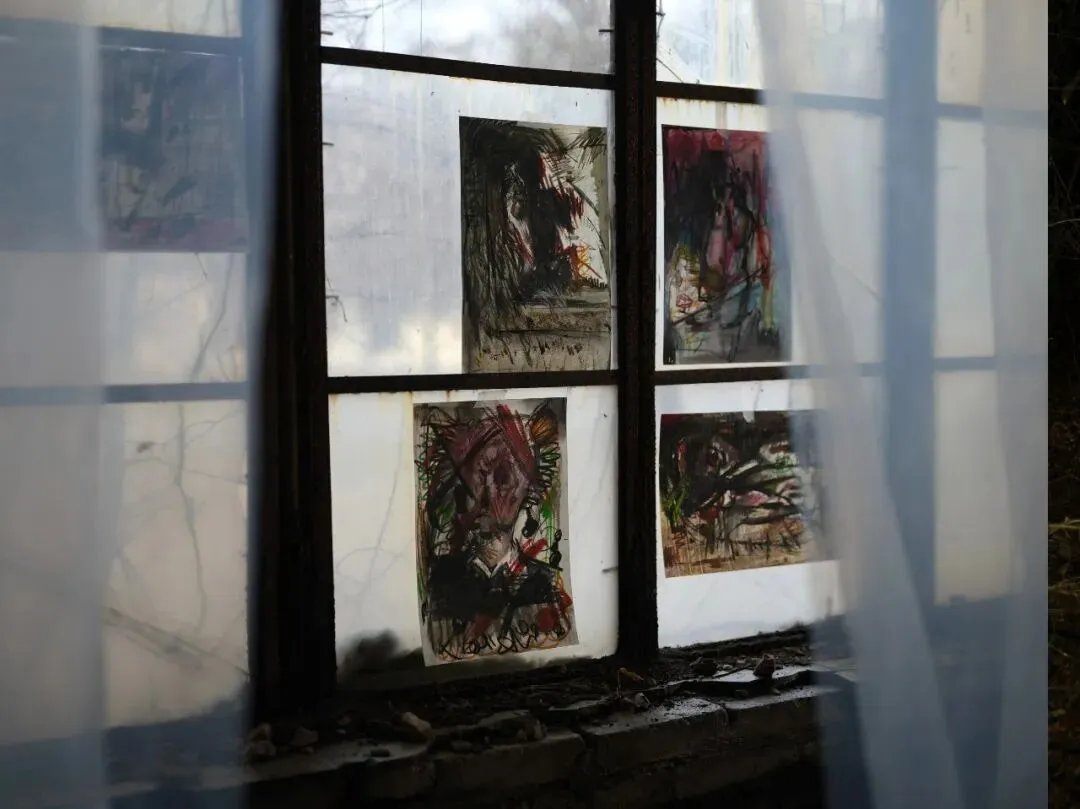
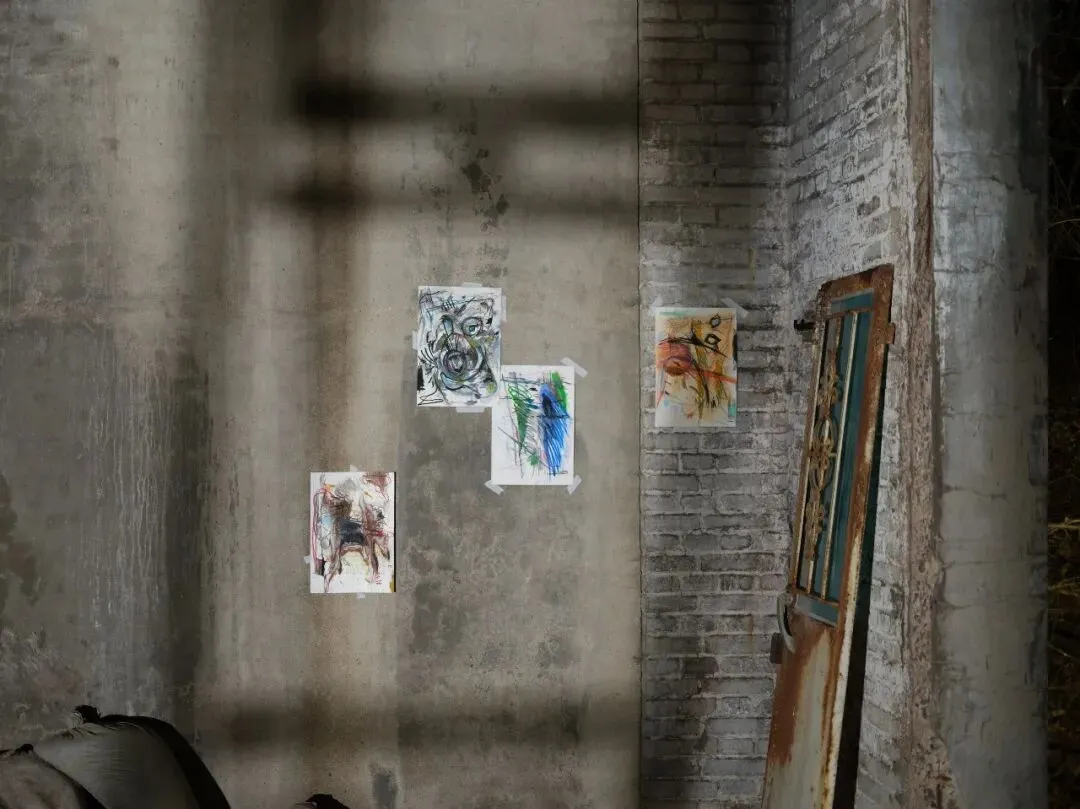
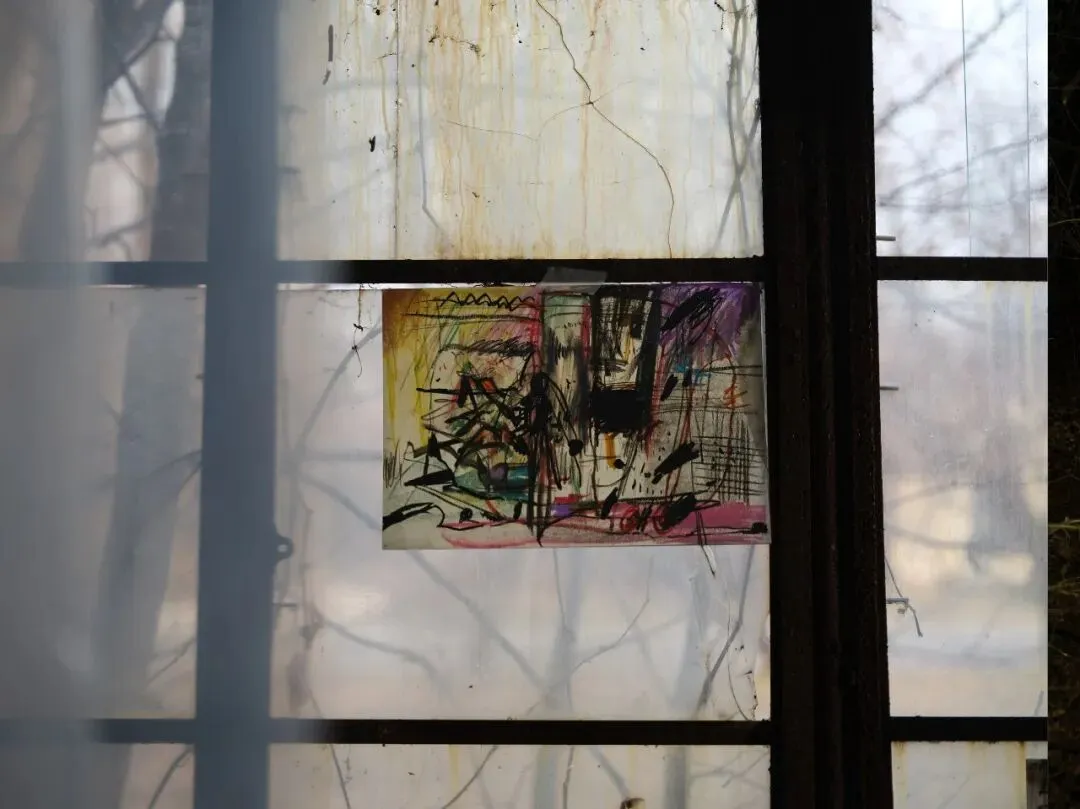
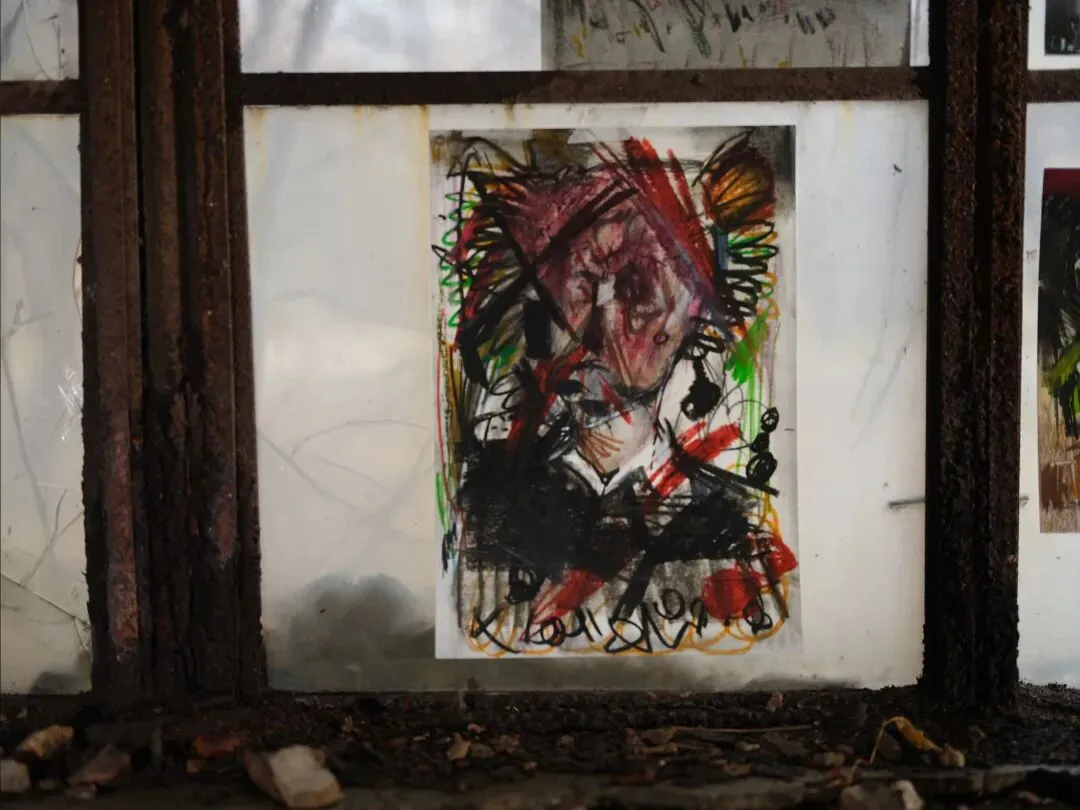
2025
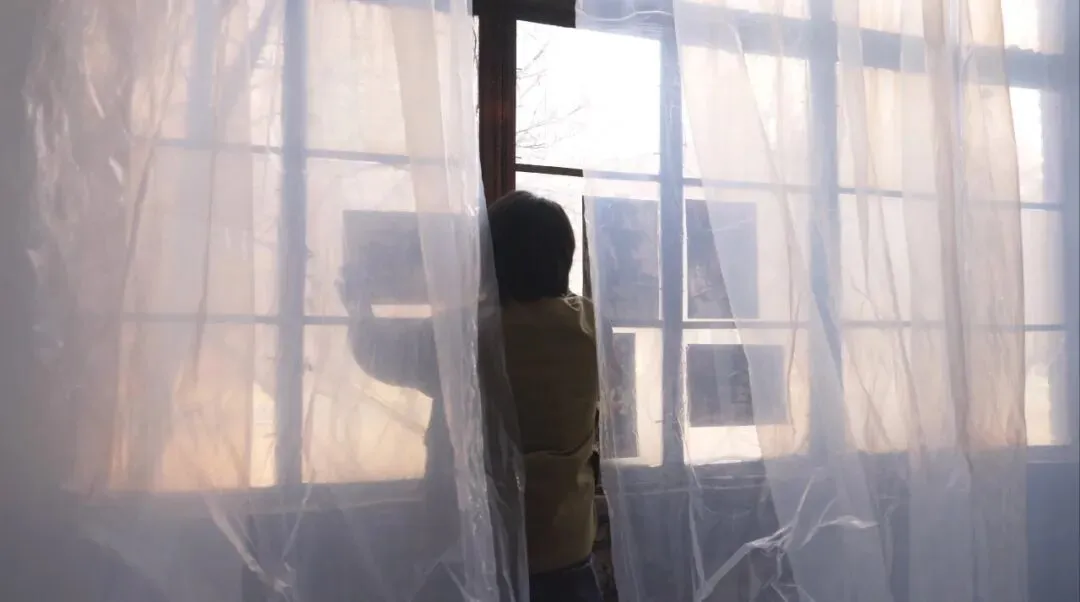
点线面构成的复杂画面,像被某种不可抗力撕裂,大量使用红、黑、灰蓝等压抑色调,契合东北的环境色彩,精确捕捉了时代的沮丧和彷徨伤感。这组作品被他命名为《易燃的表面》,成为一种在地存档,对被城市塑造的“钢铁人格”及其代价发出追问。
Chapter 6
The Flammable Surface
After returning to China and shuttling between Beijing and Shenyang, Wang Churan—now a teaching assistant in the Department of Architecture at the Lu XunAcademy of Fine Arts—found himself with more time to observe the urban developmental history of Northeast China from a freshly calibrated perspective. He also developed a more nuanced understanding of the people of his hometown and the textures of their everyday existence.
He turned to works on paper. Using mixed media—carbon dust, crayon, pastel, and the like—and orchestrating points, lines, and planes, he created a reverberation uniquely belonging to the Northeast. The carbon materials themselves are coarse and friable, bearing a sense of incompleteness that allows him to more freely generate textures of scratching, accumulation, and abrasion. Beneath the seemingly casual scribbles of “chaotic lines” lies a response to the latent order inscribed in the industrial ruins of the Northeast.
The intricate compositions of points, lines, and planes appear torn apart by some irresistible force. A somber palette dominates—reds, blacks, grayish blues—resonating with the environmental colors of the Northeast and capturing precisely the despondency, disorientation, and melancholy of the era.
He titled this body of work The Flammable Surface, rendering it a form of site‑specific archiving that interrogates the “Steel Persona” forged by the city and the price it has exacted.
Swipe to see more
关于艺术家
About the Artist
王楚然
2001年出生于中国辽宁鞍山,现生活和工作于北京。
教育经历
2024-2026,鲁迅美术学院,建筑学硕士在读
2024-2025,英国皇家艺术学院,城市设计硕士
2019-2023,鲁迅美术学院,城市规划本科
获奖
2025,八届EPACC国际环保公益设计,银奖
2024,第六届香港当代设计奖,铜奖
2024,北美艺术设计大赛,绿色公共社区规划设计方案
2022,芬兰AG设计奖,中芬国际文化艺术交流双年展,银奖
2022,第三届东方创意之星大赛获奖
2021,ICDA国际当代大学生美术设计大赛,银奖
2021,国际大学生手绘艺术与设计大赛,获奖
2021,全国青年荣耀,学生组三等奖
2021,全国青年荣耀,个人二等奖
个展
2026,静默的爆裂,环岛艺术中心,北京
群展
2024,皇家艺术学建筑学院MS课程肯辛顿演播厅参展
2024,全国美展,巡回参展
2021,鉴古建今实体教学交流展
Wang Churan
Born in Anshan, Liaoning Province, China, in 2001.Currently lives and works in Beijing.
Education
2024–2026 Master of Architecture, Lu Xun Academy of Fine Arts (ongoing)
2024–2025 Master of Urban Design, Royal College of Art, UK
2019–2023 Bachelor of Urban Planning, Lu Xun Academy of Fine Arts
Awards
2025,Silver Award,8th EPACC International Environmental Public Welfare Design Competition
2024,Bronze Award, 6th Hong Kong Contemporary Design Award
2024,Award-winning Entry – Green Community Planning Design, North American Art & Design Competition
2022,Silver Award, Finland AG Design Award & China-Finland International Cultural and Art Biennale
2022,Winner, 3rd Oriental Star Creative Competition
2021,Silver Award, ICDA International Contemporary College Art & Design Competition
2021,Winner, International College Hand-Drawn Art & Design Competition
2021,Third Prize (Student Group), National Youth Honor Competition
2021,Second Prize (Individual), National Youth Honor Competition
Solo Exhibition
2026,Silent Detonation, Roundabout Art Center, Beijing
Group Exhibitions
2024,Exhibition, Kensington Showroom, School of Architecture, Royal College of Art
2024,National Art Exhibition (National Touring Exhibition)
2021,Participation in the Architectural Heritage Research & Exchange Exhibition
Swipe to see more
关于策展人
About the Curator

王嫣芸
Since shifting her focus to architectural research in 2022, she has been awarded four international architectural design honors. During her studies in Sustainability Leadership at the University of Cambridge, she turned her research focus to the Global South and founded Masa Archive.
“Masa” means “wilderness” or “open land” in Swahili, the lingua franca of East Africa, and phonetically echoes the Spanish word “mas”, signifying “more” and “beyond”. Masa Archive is dedicated to showcasing artworks from the Global South. It explores how artists situated within complex power dynamics of the Global South perceive and represent their own cultures.
Swipe to see more
学术主持
Academic Host
夏海明
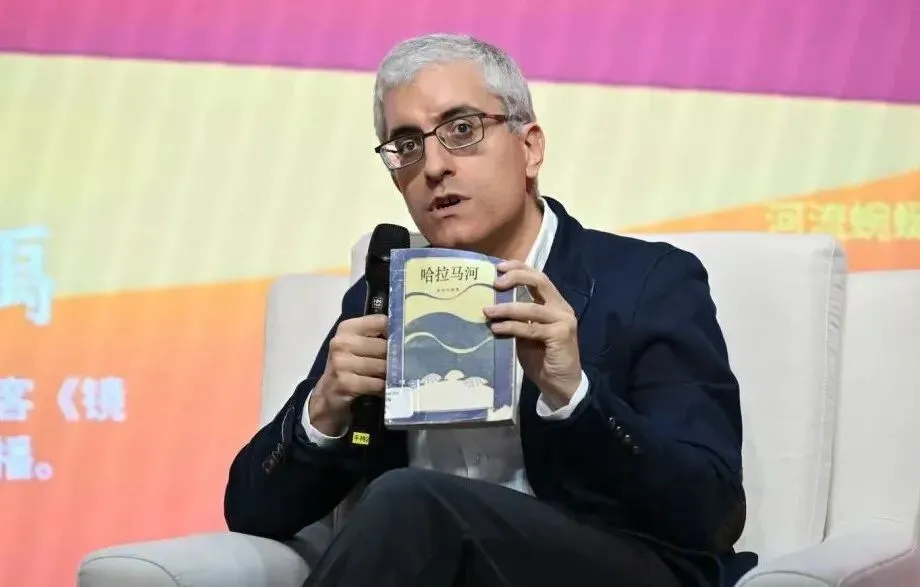
西班牙籍译者、汉学家和出版人。毕业于巴塞罗那自治大学翻译系,长期从事中国文学译介工作。主要译作包括刘慈欣的《三体III·死神永生》,宝树的《三体X·观想之宙》,郝景芳的《流浪苍穹》等科幻文学作品,还有陈彦的《主角》以及阿来的《尘埃落定》。在北京西班牙文化中心塞万提斯学院和北京外国语大学授课,所教的课程包括西班牙语和中西翻译。除此之外,他也是丝绸脉络出版社(Arterias de Seda Editorial)的创始人和总编辑,是专注于给西班牙语地区的读者们介绍中国现代文学、巴塞罗那注册的出版公司。为了感谢他在中国文学“走出去”工作中所作的贡献,中国作家协会授予他“中国文学之友”证书。
A Spanish translator,sinologist and publisher. He graduated from the Department of Translation, Universitat Autònoma de Barcelona, and has long been engaged in the translation and dissemination of Chinese literature.
His major translations include science fiction works such as Liu Cixin’s Death’s End, Bao Shu’s The Three-Body X, and Hao Jingfang’s The Wandering Earth, as well as literary classics including Chen Yan’s The Protagonist and Alai’s Red Poppies.
He has taught Spanish and Sino-Spanish translation courses at the Instituto Cervantes (Spanish Cultural Center in Beijing) and Beijing Foreign Studies University.Additionally, he is the founder and editor-in-chief of Arterias de Seda Editorial (Silk Veins Press). Registered in Barcelona, the publishing house focuses on introducing contemporary Chinese literature to Spanish-speaking readers.In recognition of his outstanding contributions to the global promotion of Chinese literature, the Chinese Writers Association awarded him the title of Friend of Chinese Literature.
Swipe to see more