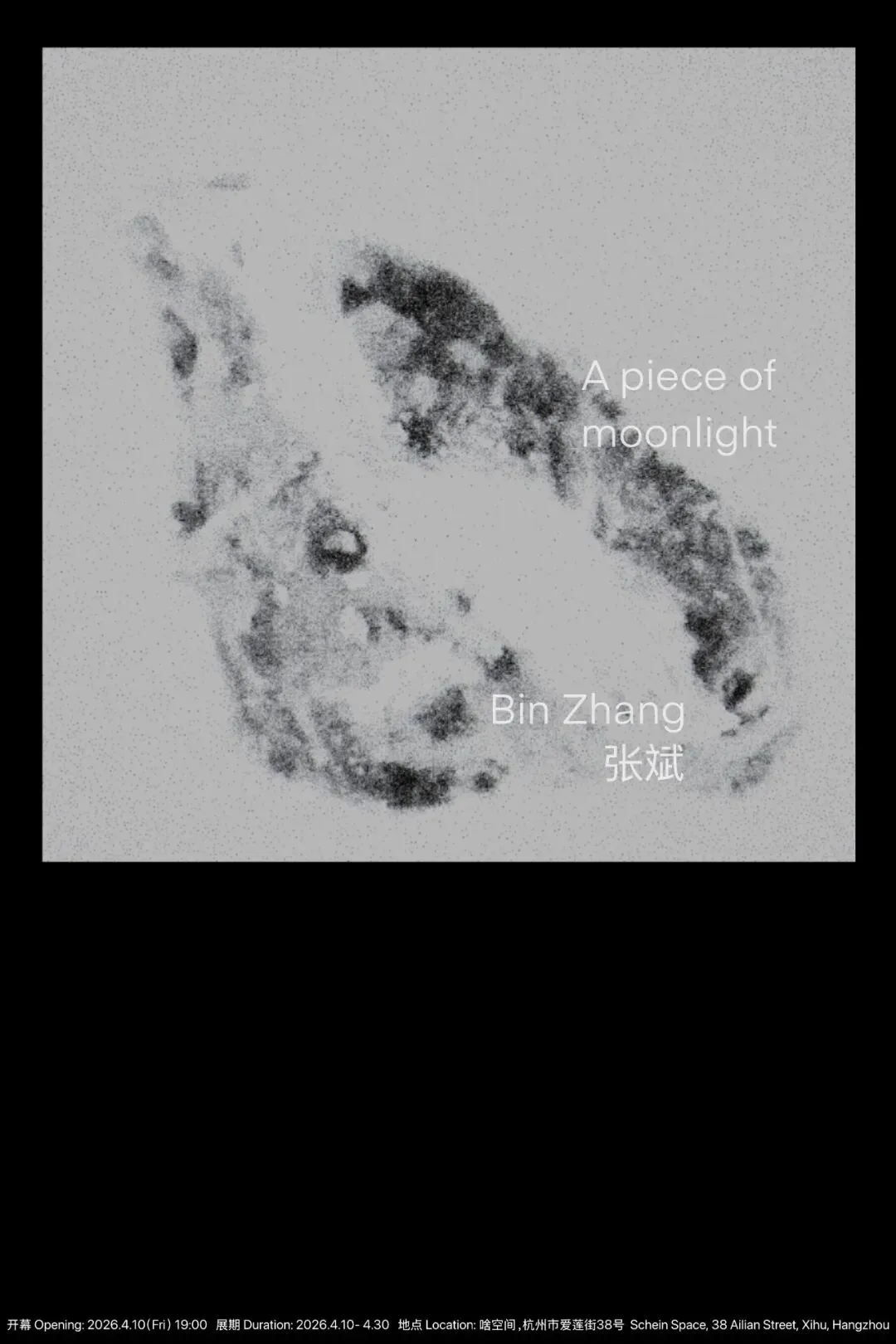
张斌:A piece of moonlight
Bin Zhang:A piece of moonlight
开幕 Opening: 2026.4.10(五) 19:00
展期 Duration: 2026.4.10- 4.30
地点 Location: 啥空间,杭州市爱莲街38号 Schein Space, 38 Ailian Street, Xihu, Hangzhou

啥空间(Schein Space)欣然宣布,将于2026年4月10日带来艺术家张斌的个人项目A piece of moonlight,展览持续至2026年4月30日,欢迎大家前来观展。
一
人的心理结构在很大程度上来自于地方。人类学中常以“地方性”来描述这一经验,它并非单纯的地理概念,而是在反复的生活实践中形成的一种方式。对张斌而言,这种“地方性”更多体现为一种身体经验——即便离开原本的环境,它仍然停留在身体的记忆之中。
在当代城市不断更新与拆除的过程中,地方的空间结构被持续重组。更新之后,原有的地方消失了,但记忆中仍然保留着它的坐标。它像一个锚点,也像一种引力,在日常中难以被直接感知,只有在失重或远离的时候,人们才会意识到,始终有某种力量在牵引着自己。
二
本次展览呈现的两组作品,以极其微弱的物质线索,构成了一次关于地方经验的微小实验。《一块月光》以一块来自拆迁现场的保温砖碎片为材料。对于艺术家而言,这类材料并非中性的建筑残余,而是某种地方经验留下的物质痕迹。当这些碎块被涂覆反光涂料并悬浮于展示装置之中时,它们既像月壤,也像从现实空间中被暂时剥离出来的记忆碎片,成为介于废墟、模型与宇宙想象之间的模糊对象。

再一次,越过地平线
影像装置/⽉陨⽯、荧光涂料、3D铝合⾦打印、⽊板、Musou black涂料/2025
另一件作品《再一次,越过地平线》则将这种尺度转换进一步推向宇宙维度。艺术家将月陨石研磨为粉末并铸成弯月形态,使其随卫星进入轨道。当它进入地球阴影、远离太阳光照时,荧光材料会释放出微弱光芒,一个极其微小的“月亮”因此在地球周围缓慢运行。作品将“地平线”这一传统的视觉界线转化为一种轨道结构:越过地平线,不再意味着消失,而是进入另一种不可见的运行状态。
展览空间被处理为近乎完全的暗场,观众必须通过手持光源来激活观看。光线不再只是照明工具,而成为一种激活观看的装置:观看行为在此被转化为一次临时的坐标对齐——身体、光线与视线在黑暗中形成短暂的关系结构。
三
在这种结构中,废墟中的砖块与来自宇宙的陨石形成一种微妙的对照:前者来自具体的地方经验,后者来自遥远的宇宙物质。二者在展览中被并置为某种“残余”,既脱离原有的主体结构,也成为重新标记空间与时间的坐标。在这些作品中,艺术家反复使用“微弱光源”作为一种工作方法。无论是反光涂料还是荧光材料,光并不是用来照亮空间,而更像一种几乎不可察觉的信号——只有当观众主动靠近时,它才会显现出来。
当地方不再以完整的地理形态存在,而以碎片、轨迹与微光的方式出现时,引力便不再只是物理意义上的力,而是一种持续牵引记忆与经验的连结。
Schein Space is pleased to present A Piece of Moonlight, a solo project by the artist Bin Zhang, opening on April 10, 2026. The exhibition will remain on view until April 30, 2026. We warmly welcome visitors to experience the exhibition.
I
To a large extent, a person’s psychological structure is shaped by place. In anthropology, this experience is often described through the notion of “locality”—not merely a geographical designation, but a mode of being formed through repeated practices of everyday life. For Zhang Bin, such locality manifests primarily as a bodily experience: even after leaving a place, it persists as a form of memory inscribed within the body.
Amid the constant cycles of renewal and demolition that characterize the contemporary city, the spatial structures of place are continually reorganized. After redevelopment, the original place may disappear, yet its coordinates remain within memory. It functions both as an anchor and as a form of gravity—difficult to perceive in the routines of daily life. Only in moments of weightlessness or distance do we begin to recognize that some unseen force has always been pulling us back.
II
The two groups of works presented in this exhibition form a subtle experiment in place-based experience through extremely minimal material traces. A Piece of Moonlight takes as its material a fragment of insulation brick collected from a demolition site. For the artist, such material is not a neutral remnant of construction but a physical trace left behind by a particular locality. When these fragments are coated with reflective paint and suspended within the display structure, they appear simultaneously as lunar soil and as shards of memory temporarily detached from real space—ambiguous objects situated somewhere between ruin, model, and cosmic imagination.
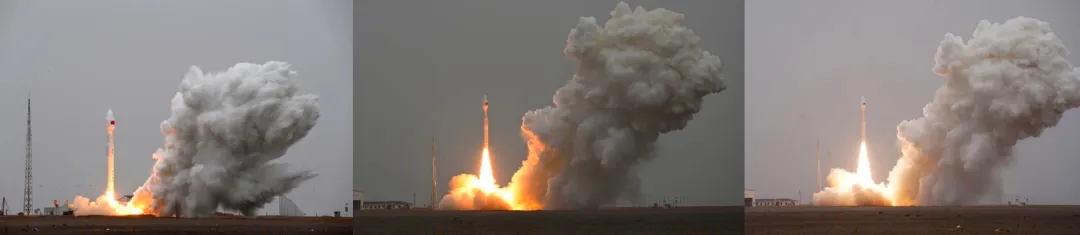
© 中科宇航
Another work, Once Again, Beyond the Horizon, extends this shift in scale toward a cosmic dimension. The artist grinds lunar meteorite into powder and casts it into the form of a crescent, allowing it to enter orbit aboard a satellite. When it passes into the Earth’s shadow and away from sunlight, the fluorescent material emits a faint glow. A minuscule “moon” thus slowly circles the planet. In this work, the horizon—traditionally understood as a visual boundary—is transformed into an orbital structure: to pass beyond the horizon no longer means disappearance, but entry into another, invisible mode of movement.
The exhibition space itself is treated as an almost complete dark field. Viewers must activate their perception using handheld light sources. Light no longer functions merely as illumination but as a device that triggers the act of seeing. Viewing becomes a temporary alignment of coordinates: body, light, and gaze forming a fleeting relational structure within the darkness.
III
Within this structure, the brick fragments from the ruins and the meteorite originating from outer space form a subtle juxtaposition. The former emerges from a specific local experience, while the latter comes from distant cosmic matter. Presented together in the exhibition, both become forms of residue—detached from their original structures while simultaneously functioning as coordinates that re-mark space and time.
Across these works, the artist repeatedly employs weak sources of light as a working method. Whether reflective coatings or fluorescent materials, light here is not meant to illuminate space but rather to operate as a nearly imperceptible signal—something that only reveals itself when the viewer actively approaches.
When place no longer exists as a complete geographical entity but instead appears through fragments, trajectories, and faint glimmers, gravity ceases to be merely a physical force. It becomes a persistent connection that continues to draw memory and experience toward one another.

关于艺术家
张斌(b.1996)出生于福建仙游,硕士毕业于中国美术学院纤维空间艺术工作室,现生活和工作于杭州。其创作跨越影像、装置与绘画等多种媒介,在直觉驱动的表达中呈现出一种带有浪漫主义气质的感知方式。艺术家常以个体经验为起点,将自我置于现实的坐标系之中,通过作品映射周遭世界,并在其中折射出历史、社会与日常生活的多重张力。
Bin Zhang (b. 1996) was born in Xianyou, Fujian, and received his MFA from the Fiber and Space Art Studio at the China Academy of Art. He currently lives and works in Hangzhou. His practice spans multiple media, including video, installation, and painting. Guided by an intuitive mode of expression, his works reveal a sensibility marked by a subtle romantic undertone. Taking personal experience as a point of departure, Zhang situates the self within a broader field of reality; through his works, the surrounding world is refracted, bringing into view the intertwined tensions of history, society, and everyday life.