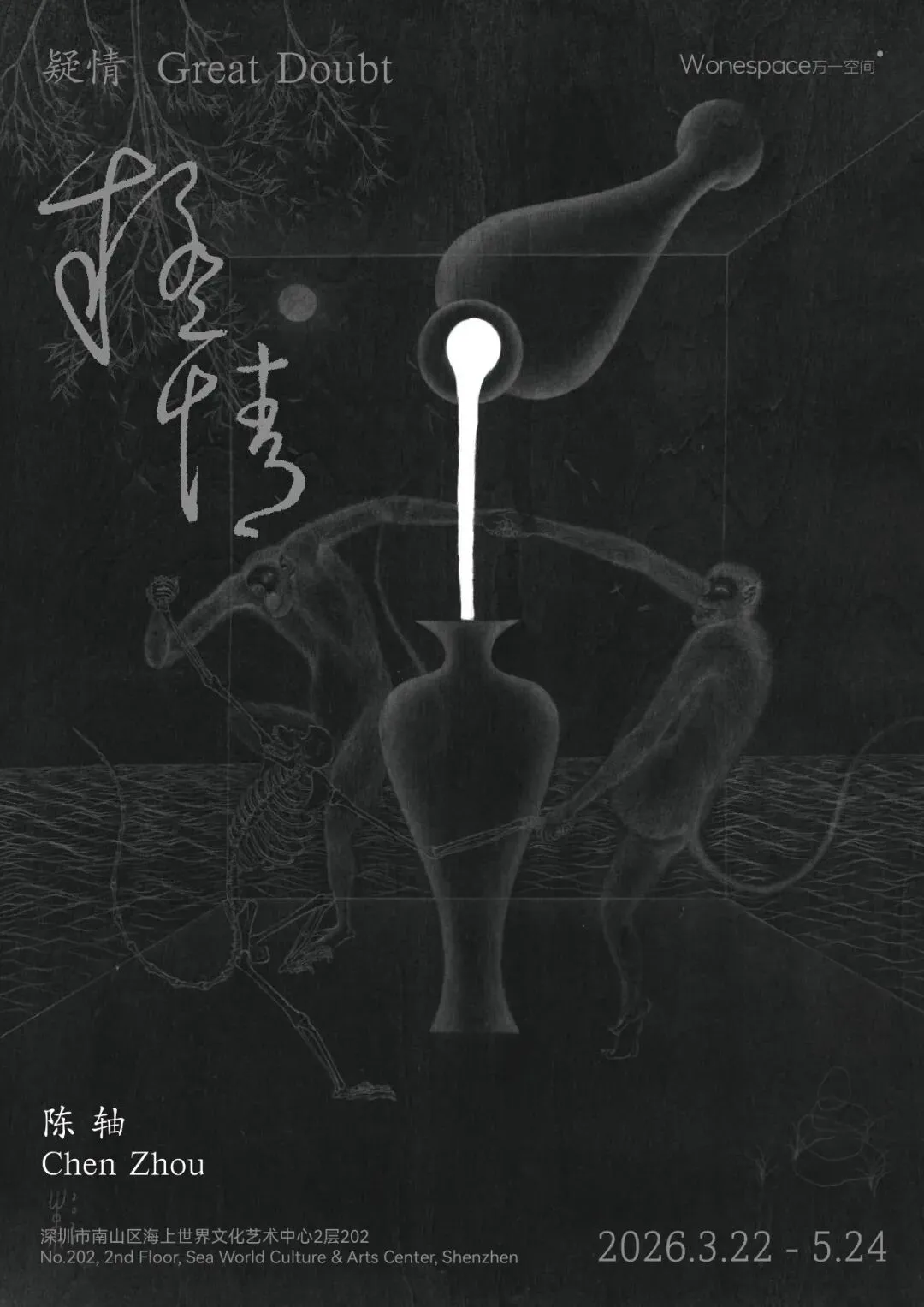
海报设计:周嘉
致谢:梅数植
我的创作在疫情后发生了一个转折,从曾经惯用的影像媒介转变为以绘画与行为表演为主的创作,媒介的变化也呈现出创作内核的演变与深化。从之前关注青年群体在当代生活的虚拟性状态,演变到对“人—生命—存在”的疑惑。
这一切转折来自于疫情中的体验,自小到大从未真正体验过全球范围的灾难,存在危机从外部世界渗透进我个人的生命体会中。充斥的死亡信息像雾霾一样笼罩在意识世界里,迫使我重新思考和衡量自己所表达的艺术的价值。当然这只是一个破裂的开始,那个时刻我只希望在烦乱的外部世界中寻回一个宁静的安心之处。
当时我有一本日本造像佛师快庆的画册,其中有一尊阿弥陀佛雕像,他呈现出的寂静自在微妙地摄受了我的心,令我感到安然平静。于是我开始临摹这尊阿弥陀佛像,但是我将他画成一个普通人的造型,只留下五官的寂静状态,因为我觉得这种状态是所有人内在本具的。
[1]在佛教语境中,虚空不是空白,而是不被阻碍、无边无际、能容万物的存在状态。
[2]在禅宗中,疑情是一个修行术语。它指的是:对一个公案或根本问题,生起的、持续不散的“大疑”状态。
After the coronavirus pandemic, my artistic creation experienced a major transition, as I shifted my attention from visual media to painting and performance art. This change of medium reflects a transformation and deepening of the core of my artistic work as I evolved from an earlier concern with the illusory condition of contemporary youth to a more fundamental inquiry into human beings, life, and existence.
This turning point grew out of my daily life experience during the pandemic. Having never before lived through a global disaster, a sense of existential crisis infiltrated my personal life from the outside world. The constant flow of information about death hung over consciousness like a curtain of smog, forcing me to reconsider the value and meaning of what I sought to express through my art. This was to be merely the beginning of a rupture in my artistic production. At that moment, I only wished to find a peaceful haven amidst the chaotic outside world.
At the time, I owned an album of sculptures by the Japanese Buddhist sculptorKaikei, which included the photograph of a standing Amitābha Buddha. The quiet, effortless serenity of this sculpture subtly drew me in and filled me with a sense of peace. I thus set about copying this work, deciding however to render Amitābha as an ordinary person, keeping only that original sense of serenity in the figure’s facial expression. I felt that this state of tranquility was something inherent to every single human being.
As I was absorbed in this new project, my four-year-old son, Chen Zaimeng, came over one day and asked if he could collaborate with me. In the past, I had often invited him to paint together with me, but this time I hesitated, worried that his “doodles” would disrupt the calm of Amitābha’s image, and also concerned that this could be interpreted as an act of disrespect towards Buddha. But as I reconsidered this idea, I also became aware of my own inner thoughts: if such a small disturbance could shatter my inner tranquility, how would I succeed in painting Amitābha? Moreover, in Buddhism, form is ultimately formless, so why stubbornly cling to the image itself when no ill intent was involved? I thus agreed reluctantly. Standing behind him, I watched as he freely “doodled” over my image with his colored pencils.
When he finished, I realized that his random marks had not destroyed the stillness of the figure at all. Instead, the stillness had receded into the picture’s background, thus becoming even more profound. Stillness and chaos coexisted peacefully within the same plane. In that moment, I realized that stillness is constant and indestructible. Even within noise, stillness remains as a background, like the Void itself. This insight became a keynote of my later paintings.
In the painting series The Absence Itself, I began painting bottles as substitutes for the meditative stillness previously embodied by the Buddha image. This was inspired by a line from the Śūraṅgama Sūtra (Sūtra of the Heroic March): “Like purifying muddy water in a quiet vessel left completely still, the sand and mud settle, and the pure water appears.” A vase is a hollow vessel; whether it stands or is shattered, it seems to always point to the Void[1]. When I think of vases, the first form that comes to mind is that of the Guanyin vase, also known as the “Guanyin vessel”, so named because its shape evokes that of a standing human body, with a head and shoulders. When I paint this kind of vase, it feels as if I am painting a person—one that is absorbed in meditation, exuding a tranquil state of existence.
During that period, I was also practicing seated meditation. In meditation, I experienced a state of stillness that bordered on Emptiness: sound dissolved into a formless flow, mental images arose and faded, the boundaries between body and space became indistinct, and time and space seemed to overlap. Later, I integrated all of these experiences into my painting series The Absence Itself. This title reflects a paradoxical state encountered in meditation, where the experience of existence becomes abstract—neither fully present nor absent. And this feeling can carry over into daily life, loosening one’s sense of reality. This is actually not a particularly unusual experience and may be likened to that half-detached state of consciousness that inhabits us just before sleep sets in. Anyone who becomes truly still may sense it, though we rarely notice it in our daily lives. I hope that my paintings may capture this delicate experience.
At this point, I feel the need to explain why I insist on using lead pencils as my primary drawing medium. Diverse reasons have directed me towards this choice. One is that my work turned more toward physical presence and bodily energy after the pandemic, which is also why I began experimenting with performance art around the same time. Moreover, graphite itself is endowed with a quiet, restrained quality. It carries a subtle sense of weight—downward-moving, and stable. Its fine strokes can sensitively convey delicate perceptions. Due to its small size, the handling of the pencil’s tip requires sustained bodily labor, while the ensuing graphite traces must be completed through rubbing and smudging with the hand and fingers. For me, the pencil is a simple yet direct tool adequate for transmitting bodily energy. Following this line of thought, the act of painting thus becomes a process of projecting and infusing intention and energy into my work.
In The Absence Itself series, I began creating diptychs and triptychs (in this, I was to some extent influenced by Francis Bacon), aiming at imbuing these paintings with narrative associations. During this stage, I developed a chaotic world grounded in stillness. The Guanyin vase remained a central figure, as if undergoing cycles of rebirth across different time periods and spaces. This approach culminated in the 7.7 meter-long long scroll Travelling Amid.
While working on The Absence Itself, I sensed an intuitive connection between my work and traditional Chinese landscape painting. In both cases, the artist projects inner experience of time and space onto his image. I thus began to consciously study Chinese landscape painting, tracing the evolution of its spatial composition, from the three traditional perspectives to the long scroll. Historically, landscape imagery is always rooted in the painter’s lived experience of the natural world. When compared to former times, I personally believe that contemporary experiences of time and space involve additional dimensions: the spatial experience of urban architecture, the mental dimension of virtual networks, the spatial logic of abstraction and collage, as well as the emotional connection to ancient landscape paintings. Today, these complex experiences exist in a layered, overlapping state. This became the conceptual basis of Travelling Amid: a work in the form of a traditional long scroll, in which time and space are interwoven in multiple layers, and in which the traveller hinted to in the title is absent.
Having created a series of works connected to a world immersed in a state of primal chaos, I felt the need to reduce and simplify my content, so as to return to that original purity where stillness and chaos coexist. This is a dual world: stillness and movement, interior and exterior, spirit and matter, subject and projection, self and other. So I decided to simply paint only two vases. From my perspective, the concept of “Two” contains an unfathomable mystery: how is it that One produced Two? An intangible mirror seems to stand between the two.
This new pursuit also encouraged me to begin painting on wood panels. Working on small panels, I created a space with two vases, and carried out repeated experiments in which I constantly readjusted the vases’ position within that same space. Each rearrangement produced subtle changes in perception, although each of these paintings remained pervaded by that same essential tranquility. The wood grain itself created a sense of dynamic fluidity, naturally evoking a primeval state of chaos in constant evolution. By tracing the grain, I intentionally revealed these “currents.” In a way, I was collaborating with the wood grain, just as I had once collaborated with my son. Every time I began a new panel, I would first try to feel what the wood grain of that particular panel evoked in me. This would inspire the way in which I would then arrange the two vases. I titled this series Where the Body Is No Longer Known. These works exude a sense of great doubt: is it one or two, is it the self and the other, or the self observing itself? Through this series, I hope to succeed in transmitting this kind of questioning to the viewer[2].
My probings into the mystery of “Two” spilled over into the Two Monkeys series, which draws its inspiration from traditional Chinese painting, and especially from Zen depictions of monkeys. In ancient Chinese paintings, monkeys often symbolized the Buddhist concept of the “monkey-mind”, thus serving as a metaphor for the restless and active state of human thoughts. From there, I began rendering the wood grain more figuratively, transforming it into suns, moons, mountains, rivers, clouds, and mist. I would then place two monkeys within these scenes, as if acting out a play—a play of cyclical transmigration between life and death, half-way between consciousness and slumber. As I did often depict the moon, I would paint my panels black so as to evoke the night. Going over the black surface, the traces left by my graphite pencil actually turned into silver light. I realized that silver is the light of the night, just as gold is the light of the day.
I am now waiting for gold to enter into my future works. The monkey series is still in the making. Many works are about death, but not in a fearful or pessimistic way. Rather, they resemble a game of saṃsāra. Śākyamuni Buddha described sleep as a “small daze” and death as a “great daze,” meaning that one awakens again, and that consciousness is not extinguished while the body transforms. In future works, I believe that the pair of vases may transform into other forms, such a pair of oxen, elephants, birds, butterflies, trees, or flowers. Everything is in flux.
Looking back, I realize that there is one element in my painting that has never changed: the background space. As I begin each one of my paintings, I first sketch out this space with just a few lines. Once it appears, it feels like an open space has just come into existence. Gazing into it, images begin to arise, as if emerging from emptiness. I have finally come to understand that the original tranquility embodied by Amitābha Buddha ultimately transformed into this unchanging space. From this empty place, all images arise. It turns out that this constant, open space is the place of solace I have been seeking all along.
[1] In Buddhism, Void, or Emptiness, must not be understood as an absence of matter or nothingness, but as an unobstructed, boundless state that can contain the existence of all beings.
[2] In Zen Buddhism, “great doubt” (yíqíng) designates a sustained, unresolved inquiry arising from a kōan, or a fundamental question.
请向下滑动文字 Please swipe down the text
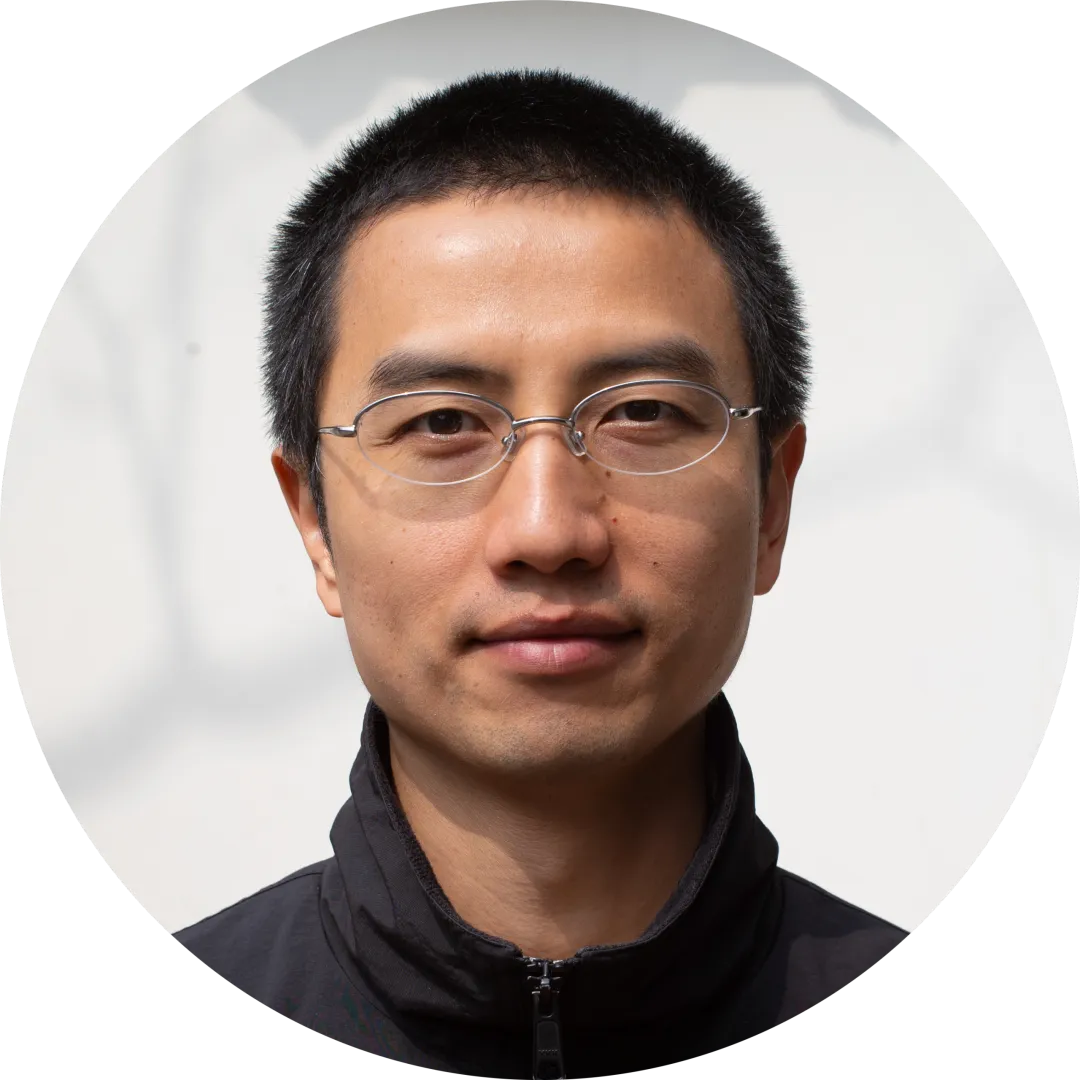
陈轴,1987年生于浙江,毕业于北京中央美术学院,现工作生活于上海。他以绘画、影像和行为表演为主要创作媒介,长期关注现代人的存在体验。其早期创作以影像为主,聚焦当代生活的荒诞与虚拟世界的孤独。近年来他的实践更多涉及绘画与行为表演,其长期研习的佛家思想逐渐渗入创作,在创作中追求内在精神力、静谧感,以形成独具个人特色的东方超现实色彩风格。